by Amir Iqbal
South Africa has no ban on foreign property buyers, no stamp duty, and a transfer tax that is zero on the first R1.21 million of value — but the tax bill does not end at the purchase. Municipal rates, tax on rent, capital gains tax on sale and a withholding tax that can hold back far more than you actually owe all need budgeting. This guide explains property taxes in South Africa for foreign buyers step by step, using the rates in force for 2026/27, so you can see the full cost before you sign an offer to purchase.
Who Can Buy Property in South Africa From Abroad
There is no restriction on foreign ownership of residential property in South Africa. A non-resident can buy a house, a flat or a plot in their own name, in a South African company or through a trust, and the property is registered in the Deeds Office in the same way as for a South African buyer. No government approval is needed to buy.
Money is where the rules bite. Funds must enter South Africa through an authorised dealer — in practice your bank — and the transfer must be recorded as a property purchase, because you will need that paper trail when you later sell and want to take the money out again. Keep every bank record, the sale agreement and the transfer duty receipt. The conveyancer will also need FICA documents from you: a passport, proof of your address abroad and proof of where the money came from. A South African bank account is not compulsory, but it makes paying rates, levies and tax far easier, and most non-resident buyers open one.
Foreign buyers can get a bond, but banks lend more cautiously to non-residents — expect a loan of around half the purchase price, and the bank will want proof of income and a clean credit record in your home country. Land reform is also worth knowing about: the Expropriation Act signed in 2025 allows expropriation with no compensation in defined circumstances, though it has not been used against ordinary residential property.
Transfer Duty: The Sliding Scale
Transfer duty is the tax SARS charges when you acquire property, and the buyer pays it. It is charged on the higher of the purchase price and the fair market value, not on the bond amount, and it is calculated on a sliding scale. The table below is the SARS schedule in force from 1 April 2025 and unchanged from 1 April 2026.
| Value of the property | Transfer duty payable |
|---|---|
| R1 – R1,210,000 | 0% — no duty |
| R1,210,001 – R1,663,800 | 3% of the value above R1,210,000 |
| R1,663,801 – R2,329,300 | R13,614 + 6% of the value above R1,663,800 |
| R2,329,301 – R2,994,800 | R53,544 + 8% of the value above R2,329,300 |
| R2,994,801 – R13,310,000 | R106,784 + 11% of the value above R2,994,800 |
| R13,310,001 and above | R1,241,456 + 13% of the value above R13,310,000 |
Each rate applies only to the slice of value inside its band. On a R1,500,000 purchase the duty is 3% of R290,000, which is R8,700; on a R2,000,000 purchase it is R13,614 plus 6% of R336,200, which is R33,786. The schedule is set in the annual Budget and can change, so confirm the current table on the SARS website before you budget. The duty must be paid before transfer, and the Deeds Office will not register the property without a SARS transfer duty receipt or an exemption notice.
Transfer Duty or VAT — Never Both
You never pay both transfer duty and VAT on the same purchase. If the seller is a VAT vendor and the sale attracts VAT — typically a new development sold by a developer — VAT of 15% applies and no transfer duty is due. If the seller is a private individual selling a second-hand home, transfer duty applies and no VAT is due. The distinction matters because VAT is charged on the full price while transfer duty has a nil band, so a VAT purchase of the same value usually costs more in tax. Ask the seller whether the price includes VAT before you sign; a developer’s price usually does, and a private seller’s price does not.
Conveyancing Fees, Bond Costs and the Deeds Office
Transfer duty is the largest cost, but it is not the only one. The transferring attorney charges a conveyancing fee on the Legal Practice Council’s published tariff, which slides with the purchase price, plus 15% VAT. If you take a bond, the bank’s attorney charges a separate bond registration fee on a similar tariff, again plus VAT, and the bank charges its own initiation fee. The Deeds Office charges a fixed registration fee on a published schedule, from R50 to R7,751. Add the smaller disbursements — rates clearance, levy clearance for a sectional title flat, FICA compliance and the electrical, gas and plumbing certificates the seller must supply — and the non-duty costs on a mid-priced purchase run to roughly R40,000 to R60,000. Your conveyancer must give you a written quote before transfer; that quote, not a rule of thumb, is the figure to budget on.
Annual Municipal Rates
Once you own the property you pay municipal rates every month, charged by your municipality on the municipal valuation, and each municipality sets its own rate, so the same value of property costs different amounts in Cape Town, Johannesburg and Durban. Residential property is rated lower than commercial property, and most municipalities give rebates — pensioners and low-income owners can qualify for substantial relief. The valuation is set by the municipal valuer and can be objected to when the valuation roll is published. Rates are not optional: unpaid rates can block a future sale, because the municipality must issue a rates clearance certificate before transfer and the seller must settle arrears first. If you rent the property out, the rates are a deductible expense against the rent.
Tax on Rental Income
Rental income from South African property is taxable in South Africa whether or not you live there. A non-resident landlord must register with SARS and declare the rent on a tax return; there is no flat withholding tax deducted from rent, so the tax is worked out on assessment. The rent is taxed at your marginal rate on the net figure: rent received less the expenses of letting — municipal rates, levies, insurance, repairs, agent’s commission and bond interest. Individual tax rates for 2026/27 start at 18% on the first R237,100 of taxable income and rise in steps to 45% above R1,817,000. If the property is let through a South African company, the company pays tax at the corporate rate on its profit. Keep invoices for every expense, because SARS can ask for them, and short-term letting platforms do not change the treatment — the income is still rental income and still taxable.
Capital Gains Tax When You Sell
Capital gains tax is charged on the profit when you sell. The gain is the sale price minus the base cost — what you paid plus transfer duty, conveyancing fees and improvements — so keep every receipt, because each rand of base cost reduces the gain. For an individual, 40% of the gain is added to taxable income and taxed at your marginal rate; for a company or a trust, 80% is included. An individual also gets an annual exclusion of R40,000, and a primary residence exclusion of R2 million applies where the property was genuinely your primary residence. A foreign buyer who never lived in the property cannot use that exclusion, which is the single biggest difference from a resident seller. The gain is taxed in the year of sale and must be declared on a return even if you have already left the country.
The Section 35A Withholding Tax on Sale
This is the tax that most often surprises foreign sellers. Under section 35A of the Income Tax Act, when a non-resident sells immovable property for more than R2 million, the purchaser — in practice the conveyancer — must withhold a percentage of the full purchase price and pay it directly to SARS. The rate is 7.5% if the seller is a natural person, 10% if the seller is a company, and 15% if the seller is a trust. Below R2 million nothing is withheld, and above R2 million the percentage applies to the whole price, not just the amount above R2 million.
The withholding is not a final tax. It is a provisional payment held against the capital gains tax actually due, and the difference is refunded when the seller files a return for the year of sale. Because it is charged on the full price rather than on the gain, it is very often far larger than the tax owed. A seller can apply to SARS for a directive reducing or removing the withholding, using form NR03 with the sale agreement, and SARS generally processes it within 21 business days. Apply before transfer if you can; once the money is withheld, getting it back means filing a return and waiting for the refund.
Estate Duty and Donations Tax
South African estate duty applies to property situated in South Africa even if the owner lived abroad. Estate duty is charged at 20% on the dutiable value of the estate up to R30 million and 25% above R30 million, after an abatement of R3.5 million and after deducting debts and the value passing to a surviving spouse, which is fully exempt. Donations tax applies at the same 20% and 25% rates to gifts of property, with an annual exemption of R100,000 for a natural person. Take advice on whether to hold property personally, in a company or in a trust, because the estate duty outcome differs sharply between them, and a South African will can simplify administration after death.
Worked Example: Buying, Renting and Selling in Cape Town
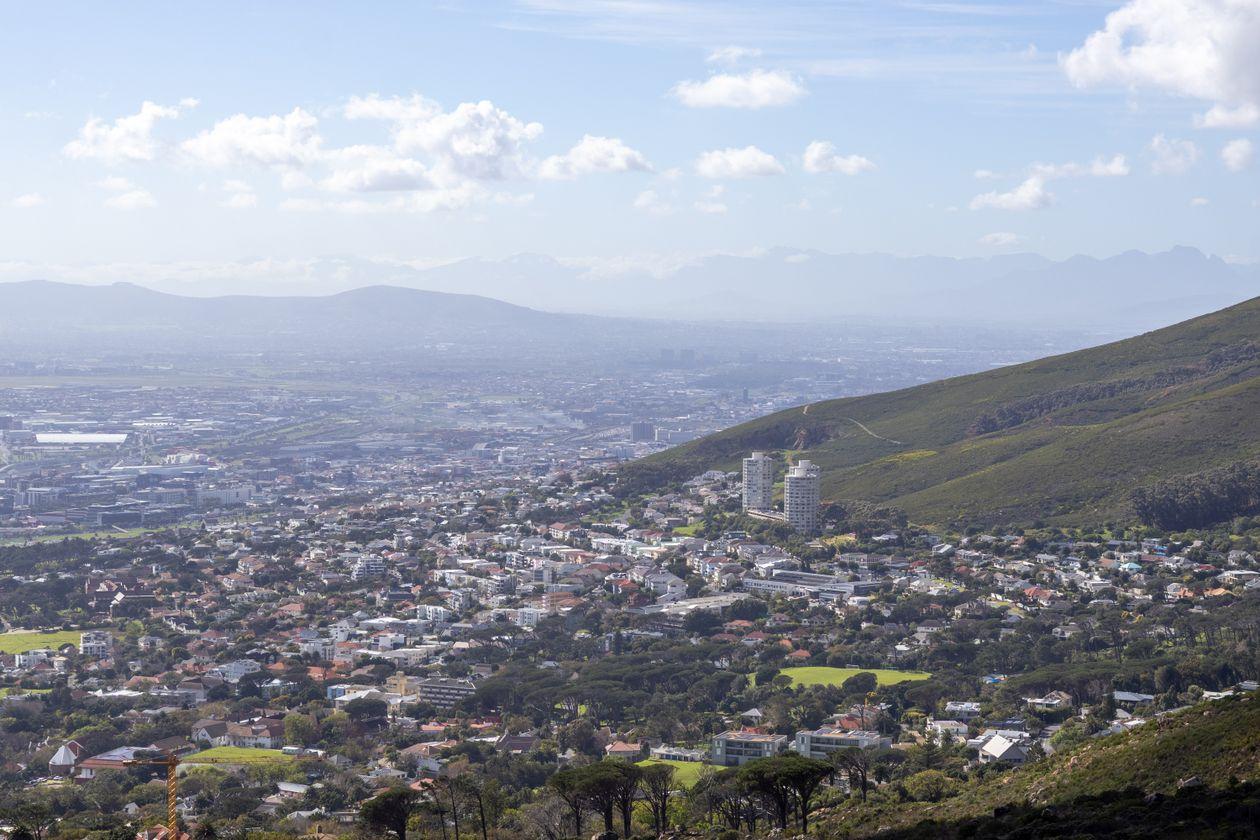
An overseas buyer purchases a second-hand apartment in Cape Town for R3,500,000 in 2026. Transfer duty falls in the band from R2,994,801 to R13,310,000: R106,784 plus 11% of the R505,200 above R2,994,800, which is R55,572, giving total duty of R162,356. Conveyancing, bond and Deeds Office costs add roughly R45,000 — an estimate your conveyancer’s quote replaces — so the all-in cost of buying is about R3,707,000.
The apartment is let for R25,000 a month, which is R300,000 a year. Deduct rates of R24,000, levies of R36,000 and maintenance of R12,000, and the net rental income is R228,000. At the 18% entry rate that is R41,040 of tax for the year. Five years later the apartment sells for R5,000,000. The gain is R1,500,000; less the R40,000 annual exclusion it is R1,460,000, and 40% of that — R584,000 — is added to taxable income. At the 18% entry rate the capital gains tax is R105,120. But section 35A withholding is 7.5% of the full R5,000,000 price, which is R375,000 — more than three times the tax actually due — so the seller is owed a refund of R269,880 when the return is assessed. The pattern runs through the whole South African system for foreign owners: the tax itself is moderate, but the withholding and the paperwork are set high, and planning in advance keeps the cash flowing.
Common Mistakes Foreign Buyers Make
The most expensive mistakes are rarely about a single rate. First, budgeting only the price and forgetting transfer duty and conveyancing add roughly 5% to 7% on top. Second, assuming the section 35A withholding is the final tax and never filing a return to claim the refund. Third, buying without keeping the bank records of how the money entered South Africa, which makes taking sale proceeds out again far harder. Fourth, claiming the R2 million primary residence exclusion on a property that was never lived in. Fifth, letting the property and never registering with SARS, which turns a small annual liability into penalties and interest. Sixth, buying in a company or trust for the wrong reason — it can help with estate duty, but it doubles the capital gains inclusion rate to 80% and raises the section 35A withholding to 10% or 15%.
Frequently Asked Questions
Can a foreigner buy property in South Africa?
Yes. There is no restriction on foreign ownership of residential property, and no approval is needed to buy. Funds must come in through an authorised dealer bank, the conveyancer needs FICA documents, and banks usually lend non-residents around half the purchase price.
How much is transfer duty on a property in South Africa?
It is a sliding scale: nothing on the first R1,210,000, then 3%, 6%, 8%, 11% and 13% on the slices of value above that, up to R13,310,000 and beyond. On a R3,500,000 purchase the duty is R162,356. If VAT applies instead, no transfer duty is due.
Do I pay tax on rent from a South African property if I live abroad?
Yes. Rental income from South African property is taxed in South Africa. You must register with SARS and declare the net rent — rent received less rates, levies, insurance, repairs and bond interest — on a tax return, taxed at your marginal rate from 18% upwards.
What is the section 35A withholding tax when a non-resident sells?
When a non-resident sells property for more than R2 million, the conveyancer must withhold 7.5% of the full price for an individual seller, 10% for a company and 15% for a trust, and pay it to SARS. It is a provisional payment against capital gains tax, not a final tax, and the excess is refunded on assessment.
How much capital gains tax do I pay as a foreign seller?
For an individual, 40% of the gain is added to taxable income after the R40,000 annual exclusion, and taxed at your marginal rate. The R2 million primary residence exclusion only applies if the property was genuinely your primary residence. Companies and trusts include 80% of the gain.
Does South Africa charge estate duty on property owned by a foreigner?
Yes. Estate duty of 20% up to R30 million and 25% above applies to South African property in a deceased estate, after a R3.5 million abatement and the full exemption for property passing to a surviving spouse. Take advice on holding structures before you buy.
That is the full picture of property taxes in South Africa for foreign buyers: no restriction on buying, transfer duty on a sliding scale with a nil band to R1,210,000, VAT instead of duty on developer sales, monthly municipal rates, rental income taxed on the net amount, capital gains tax at a 40% inclusion rate for individuals, and the section 35A withholding that holds back far more than the tax due. Our guides to property taxes in Australia for foreign buyers, property taxes in Canada for foreign buyers, property taxes in the USA for foreign buyers, property taxes in the UAE for foreign buyers and property taxes in New Zealand for foreign buyers cover the same ground for those countries.