

 by Amir Iqbal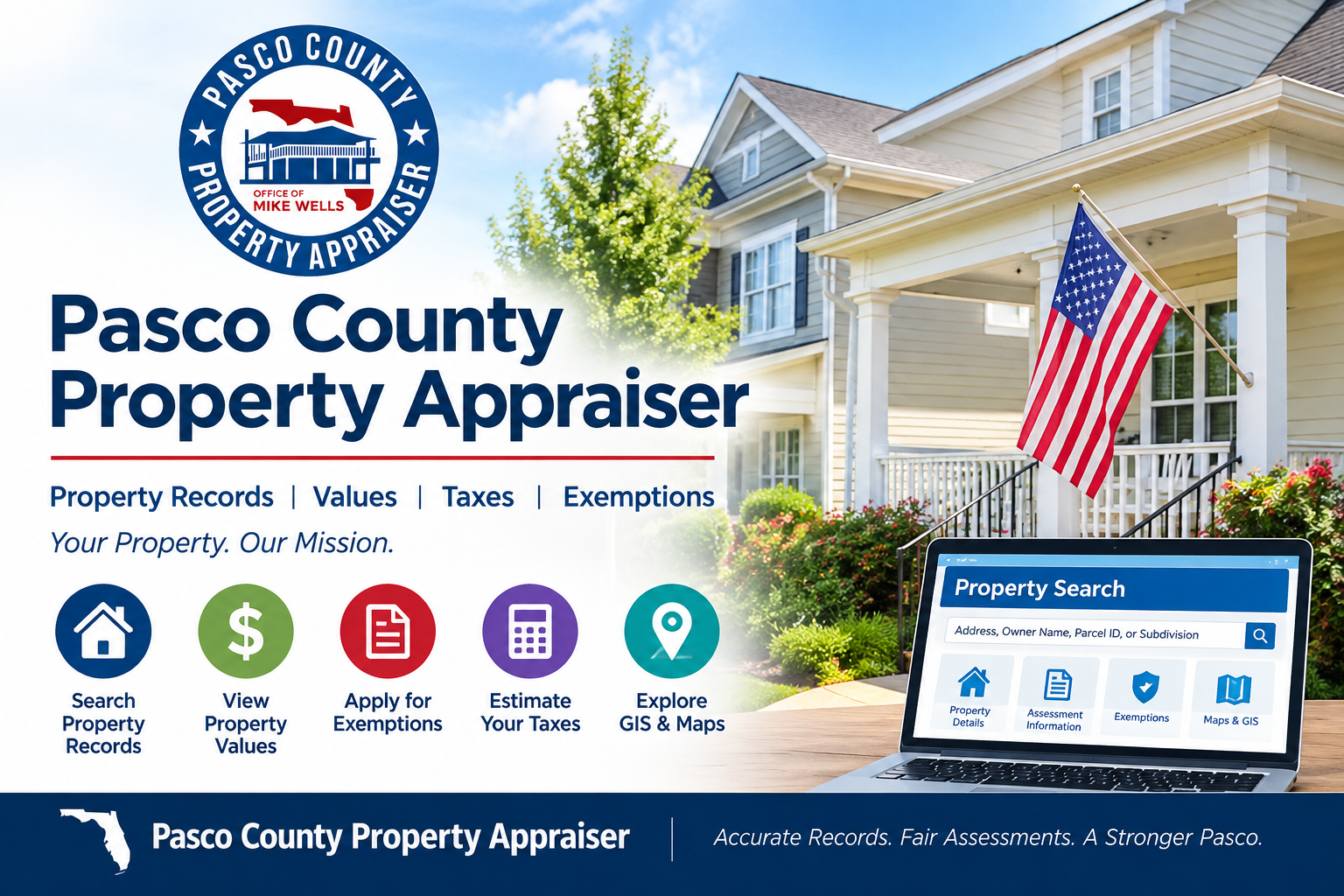
If you own a home, are buying property, or want to check property records in Pasco County, Florida, the Pasco County Property Appraiser website is one of the most useful official resources available.
Thank you for reading this post, don't forget to subscribe!The online system lets you search property information using an owner name, street address, parcel number, or subdivision. Property records can include ownership information, assessments, legal descriptions, land and building details, exemptions, and other public-record information.
This guide explains how to use the Pasco County Property Appraiser search, understand property values, check exemptions, estimate taxes, review records, and understand what to do if you disagree with an assessment.
What Is the Pasco County Property Appraiser?
The Pasco County Property Appraiser is the county office responsible for property valuation and assessment for taxation purposes. The office maintains property records and determines assessed values and exemptions used in the property-tax process.
The current official website is PascoPA.com, where residents can access property searches, exemptions, tax-estimation tools, forms, GIS information, and other resources.
It is important to understand the difference between the Property Appraiser and the Tax Collector:
| Office | Main responsibility |
|---|---|
| Property Appraiser | Determines property values and administers exemptions |
| Tax Collector | Collects property taxes |
| Value Adjustment Board | Handles formal assessment disputes |
| Clerk of Court | Maintains many recorded legal documents and deed records |
The Property Appraiser does not simply decide how much tax you pay. Tax bills are based on taxable value and the millage rates and assessments established by the applicable taxing authorities.
Pasco County Property Appraiser Search
The Pasco County Property Appraiser search is designed to help property owners, buyers, investors, researchers, and other members of the public locate property information.
According to the office’s FAQ, its online database can provide information such as ownership, assessments, legal descriptions, and other general property details. Searches can be performed using a parcel number, owner’s name, address, or subdivision criteria.
How to Search a Pasco County Property
Follow these steps:
- Visit the official Pasco County Property Appraiser website.
- Open the Records Search or property-search service.
- Choose the information you know.
- Enter the property address, owner name, or parcel number.
- Review the matching property records.
- Select the property you want to investigate.
- Review the property value, land information, building information, exemptions, and other available details.
The official search system provides different search fields and property-record options.
What Can You Find in a Pasco County Property Search?
A property record can contain several useful categories of information.
1. Property Owner
The record may show the ownership information available in the county’s property database.
2. Property Address
You can use a physical property address to locate a parcel.
3. Parcel ID
A parcel ID is a unique identifier associated with the property. It can be particularly useful when an address produces multiple results.
4. Property Value
Property records can show values such as:
- Just Value
- Assessed Value
- Taxable Value
- Land Value
- Building Value
- Extra Features
For example, current Pasco records can display property values for the 2026 tax year, although values may remain subject to change until the tax roll is certified.
5. Land Details
Property records can provide information about the land, including its classification and other characteristics.
6. Building Information
Depending on the property, records can include building characteristics and related assessment information.
7. Exemptions
A property record can show applicable exemptions and assessment reductions.
8. Legal Description
The legal description provides a formal description of the parcel used in property records.
How to Find Property Value in Pasco County
If you want to know the assessed value of a property, start with the Pasco County Property Appraiser search.
After locating the property, look at the value section of the parcel record.
You may see several different numbers. These numbers are not necessarily the same as the home’s current market price.
Just Value
Just Value is the appraised value used in the assessment process.
Assessed Value
The assessed value can be affected by Florida assessment limitations and applicable provisions such as the Save Our Homes cap.
Taxable Value
Taxable value is the amount remaining after applicable exemptions and assessment reductions are considered.
This distinction is important because two similar homes can have different taxable values and therefore different property-tax bills. The Pasco County Property Appraiser specifically explains that exemptions and the length of time they have been in effect can cause significant differences between comparable properties.
Pasco County Property Appraiser Tax Estimator
Another useful feature is the Pasco County property tax estimate.
The official process requires you to first locate the property through the records search and then select the Estimate Taxes option from the property details.
How to Estimate Property Taxes
- Open the Pasco County property search.
- Search for the property.
- Open the parcel record.
- Select Estimate Taxes.
- Review the estimated tax calculation.
Remember that an estimate is not necessarily the same as your final tax bill.
Tax bills can also include non-ad valorem assessments for services or facilities such as roads, drainage, fire, garbage, lighting, water, sewer, or other governmental services and special districts.
Pasco County Homestead Exemption
One of the most important topics for Florida homeowners is the Homestead Exemption.
The Pasco County Property Appraiser accepts Homestead Exemption applications online. The property must generally be the applicant’s permanent residence on January 1 of the year for which the exemption is being requested. The current filing deadline for the year is March 1.
Documents May Include
Depending on the applicant’s circumstances, the application can require information such as:
- Florida driver’s license or identification card
- Social Security number
- Florida vehicle registration
- Florida voter registration information
- Proof of ownership
- Recorded deed or tax bill
- Information concerning a spouse
- Immigration/residency documentation where applicable
The official requirements should be checked before submitting an application because eligibility and documentation can vary by exemption type.
Save Our Homes Cap in Pasco County
The Save Our Homes (SOH) provision is another important part of Florida’s property-assessment system.
For a property receiving Homestead Exemption, the assessed value in subsequent years is subject to statutory limits on annual increases. Pasco County explains that the limitation is generally the lower of 3% or the percentage change in the Consumer Price Index, subject to the applicable rules.
This means that a property’s assessed value and its current market value can become very different over time.
For example:
| Property situation | Possible effect |
|---|---|
| New purchase | Assessment may be established based on the applicable current assessment rules |
| Homestead property | SOH limitations may apply |
| Property improvements | Certain additions or improvements can affect assessed value |
| Change of ownership | Assessment treatment can change |
| Exemption removed | Taxable value may increase |
Always check the property’s actual record rather than assuming a neighboring property will have the same taxable value.
Other Pasco County Property Tax Exemptions
Homestead is not the only exemption available.
The Pasco County Property Appraiser lists categories including:
- Homestead
- Disability
- Veterans, Military & First Responders
- Agriculture
- Parent & Grandparent
- Senior aged 65+
Eligibility requirements differ by exemption.
For example, Pasco County has a low-income senior exemption for qualifying residents aged 65 and older. The county recommends contacting its offices for information about the application process and supporting documentation.
Pasco County Property Appraiser GIS and Maps
Property owners and buyers can also use Pasco County’s GIS and mapping resources.
GIS can be useful when you need to understand the geographic location of a parcel, investigate property boundaries, or work with countywide parcel information.
The Property Appraiser also provides GIS data downloads. Its current downloads page lists countywide parcel datasets and other geographic information.
However, GIS information should not automatically be treated as a legal survey. If exact legal boundaries are important for a transaction or construction project, consult the appropriate professional.
Pasco County Property Records for Buyers
If you are purchasing a home in Pasco County, checking the property record before closing can help you understand the property.
You can compare information such as:
- Property address
- Parcel number
- Building information
- Land details
- Recorded assessment
- Exemptions
- Previous property information available through appropriate public records
- Current assessed and taxable values
The Property Appraiser itself notes that it does not list properties for sale. Buyers looking for homes for sale should use real-estate professionals, MLS resources, or other property-listing services.
Important Tip for Buyers
Do not assume that the seller’s current tax bill will be your future tax bill.
A property can have exemptions or assessment characteristics that change after a sale. Therefore, buyers should use the official property record and tax-estimation tools when planning their future housing costs.
Pasco County Property Search by Owner Name
You can search property information using an owner’s name where the public database provides that information.
This can be useful when you know:
- The owner’s name
- The general property location
- The subdivision
- A parcel number
However, not every property owner’s information will necessarily appear publicly. Pasco County explains that certain property owners, including qualifying judges and law-enforcement personnel, may have public-disclosure protections under Florida law.
Pasco County Property Search by Address
Searching by address is one of the easiest ways to find a property when you don’t know its parcel number.
Enter the available street information into the official search system and review the matching results.
If multiple properties appear, compare:
- Street number
- Street name
- City
- Parcel ID
- Owner information
- Property characteristics
Then select the correct parcel.
Pasco County Parcel ID Search
A parcel ID is especially useful when conducting detailed research.
If you already have the parcel number from a tax document, deed, appraisal, closing document, or previous property record, entering it can help locate the exact parcel.
Pasco County’s search system uses a structured parcel format, and its FAQ provides examples of how parcel IDs are organized.
What If You Disagree With Your Property Assessment?
If you believe your property’s assessed value does not accurately reflect the applicable value, review your property record carefully.
Check:
- Land details
- Building characteristics
- Extra features
- Assessment values
- Exemptions
- Property classification
- Recent comparable information
Pasco County advises property owners to contact the Property Appraiser’s Office when they believe the just value is inaccurate or when an applicable exemption or classification is missing.
If the issue cannot be resolved, a property owner may have the option to petition the Value Adjustment Board (VAB).
The county provides specific VAB forms for real property, exemptions, agricultural property, portability, and other matters.
Informal Conference
Florida’s VAB process also allows taxpayers to request an informal conference with the property appraiser. The current DR-486 instructions explain that this conference is not required and does not change the petition filing deadline.
Because deadlines are important, homeowners should review their specific TRIM notice and current official instructions rather than relying on an old deadline found in another article.
What Is a TRIM Notice?
A TRIM notice, or Truth in Millage notice, is an important document in Florida’s annual property-tax process.
It provides information about proposed property taxes and the property’s assessed information before the final tax bill is issued.
Pasco County’s materials identify August as the period when the Notice of Proposed Property Taxes is mailed and September as the period associated with Value Adjustment Board filing deadlines, with the specific deadline appearing on the notice.
Do not ignore your TRIM notice.
If something appears incorrect, review the property record and contact the appropriate office promptly.
Pasco County Property Appraiser Offices
The Pasco County Property Appraiser has offices serving different parts of the county.
| Office | Address | Phone |
|---|---|---|
| Dade City | 14236 6th St., Suite 101, Dade City, FL 33523 | 352-521-4433 |
| Land O’ Lakes | 4111 Land O’ Lakes Blvd., Suite 106, Land O’ Lakes, FL 34639 | 813-929-2780 |
| New Port Richey | 8731 Citizens Drive, Suite 130, New Port Richey, FL 34654 | 727-847-8151 |
The listed office hours are Monday through Friday, 8:30 a.m. to 5:00 p.m., excluding legal holidays.
Pasco County Property Appraiser vs. Tax Collector
A common source of confusion is assuming the Property Appraiser collects property taxes.
It does not.
The basic process is:
Property Appraiser → Property value and exemptions
↓
Taxing authorities → Tax rates and assessments
↓
Tax Collector → Collection of the tax bill
Pasco County’s FAQ specifically states that the Tax Collector is responsible for collecting taxes.
So, if you want to:
- Find property value → Property Appraiser
- Search property records → Property Appraiser
- Apply for Homestead → Property Appraiser
- Check exemptions → Property Appraiser
- Estimate taxes → Property Appraiser
- Pay property taxes → Tax Collector
Pasco County Property Appraiser for Investors
Real-estate investors can also use county property records as part of their due diligence.
A property search can help an investor investigate:
- Parcel information
- Property characteristics
- Assessed values
- Taxable values
- Exemptions
- Land information
- Recent sales information available through county tools
- GIS information
However, government assessment records should not be treated as a complete investment analysis.
An investor should also consider:
- Current market rents
- Comparable sales
- Property condition
- Insurance
- HOA fees
- Repairs
- Financing
- Local zoning
- Flood risk
- Future development
- Actual market demand
Pasco County Tangible Personal Property
The Property Appraiser’s responsibilities also extend beyond real estate.
Businesses may have Tangible Personal Property (TPP) such as furniture, fixtures, equipment, and machinery used in business operations.
Pasco County maintains a separate TPP search and provides TPP-related forms and information.
Business owners should review the current filing requirements and deadlines directly with the Property Appraiser’s Office.
FAQs
What is the Pasco County Property Appraiser?
The Pasco County Property Appraiser is the county office responsible for property assessment, valuation, property records, and administration of property-tax exemptions.
How do I perform a Pasco County Property Appraiser search?
Visit the official Pasco County Property Appraiser website and use the records search. You can search using information such as a parcel number, owner name, address, or subdivision.
How can I find my Pasco County property value?
Search for your property on the official Property Appraiser website and review the parcel record. Look for the Just Value, Assessed Value, and Taxable Value sections.
How do I check my Pasco County property taxes?
Use the property search to locate your parcel, then select the Estimate Taxes option available from the property details.
How do I apply for Homestead Exemption in Pasco County?
Eligible homeowners can apply through the Pasco County Property Appraiser. Online Homestead applications are available, and the current-year filing deadline is March 1.
Can I search Pasco County property records by address?
Yes. The county’s property database supports address-based searches.
Can I search by parcel number?
Yes. The parcel number can be used to identify a specific property in the county’s records system.
Why is my taxable value different from my neighbor’s?
Comparable properties can have different taxable values because exemptions, assessment limitations, and other factors can differ between property owners.
What should I do if I disagree with my property assessment?
First, review the property record and contact the Property Appraiser’s Office about the issue. If it cannot be resolved, you may have the option to file a petition with the Value Adjustment Board.
Does the Pasco County Property Appraiser collect property taxes?
No. The Property Appraiser handles valuation and exemptions. The Tax Collector is responsible for collecting property taxes.
Final Takeaway
The Pasco County Property Appraiser website is a valuable starting point for anyone researching property in Pasco County, Florida.
Whether you are a homeowner checking your assessment, a buyer researching a property, an investor reviewing a parcel, or a resident applying for an exemption, the official property-search system provides important information.