
 by Amir Iqbal
How to Buy a House With No Money: 10 Ways to Buy a Home With Little or No Cash
Buying a house with no money may sound impossible, but some home buyers in the USA can purchase a property with little or even $0 down payment. Government-backed loans, down payment assistance programs, seller concessions, gifts, and other financing strategies can reduce the amount of cash you need upfront.
The important distinction is that “no money down” does not always mean “no money needed.” Buyers may still have to cover closing costs, inspections, moving expenses, earnest money, prepaid taxes, insurance, or other costs unless those expenses are covered through an eligible assistance program, seller contribution, lender credit, or another permitted source.
In this guide, ZameenInfo.com explains how to buy a house with no money, which zero-down and low-down-payment options may be available, and how first-time homebuyers can reduce their upfront costs.
Can You Buy a House With No Money Down?
Yes, some buyers can purchase a home with 0% down payment in the United States. The two major government-backed options commonly associated with zero-down financing are VA loans and USDA loans.
VA-backed purchase loans can offer eligible veterans, service members, and certain surviving spouses the ability to buy a home without a down payment. The U.S. Department of Veterans Affairs states that a VA-backed purchase loan often requires no down payment when the sales price does not exceed the home’s appraised value, although lenders can have additional requirements.
USDA home loans can also provide 100% financing for eligible buyers purchasing qualifying homes in eligible rural areas. USDA eligibility depends on factors such as household income and property location.
For buyers who do not qualify for a zero-down program, there are also low-down-payment mortgages and down payment assistance programs that can substantially reduce the amount of cash required to buy a home.
Use a VA Loan to Buy a House With $0 Down
A VA home loan can be one of the best options for eligible military borrowers who want to buy a home without a down payment.
VA-backed purchase loans are available through private lenders, while the VA guarantees a portion of the loan. Eligible borrowers can often purchase a home with no down payment and no monthly private mortgage insurance (PMI).
Who may qualify for a VA loan?
Eligibility generally depends on military service or other qualifying circumstances. Borrowers must also satisfy the lender’s credit, income, debt, and underwriting requirements.
Before applying, eligible borrowers can obtain a Certificate of Eligibility (COE) to establish their VA loan eligibility.
Benefits of a VA loan
- Potentially $0 down payment
- No monthly PMI
- Competitive mortgage terms
- Can be used by eligible first-time buyers
- Can be used to purchase certain single-family and multi-unit properties
- Some closing costs may be negotiated with the seller
However, a VA loan can still involve closing costs and, for some borrowers, a VA funding fee. Certain borrowers may qualify for an exemption from the funding fee.
Best for: Eligible veterans, active-duty service members, and other qualifying borrowers.
Consider a USDA Loan for a Zero-Down Home Purchase
A USDA home loan may allow eligible buyers to purchase a qualifying property without a traditional down payment.
USDA programs are designed to support homeownership in eligible rural and suburban areas. Your household income must generally fall within applicable USDA limits, and the property must meet USDA location and program requirements.
Why USDA loans are attractive
A USDA loan may help buyers who:
- Have limited savings
- Are purchasing their first home
- Have moderate or qualifying household income
- Want to live outside major urban areas
- Meet USDA property and borrower requirements
Before choosing a property, check whether the address is located within a USDA-eligible area.
Best for: Buyers who meet USDA income requirements and are comfortable purchasing a home in an eligible area.
Apply for Down Payment Assistance Programs
If you don’t qualify for a VA or USDA loan, down payment assistance (DPA) may help you buy a home with much less cash.
Down payment assistance can come in different forms, including:
- Grants
- Deferred-payment loans
- Forgivable loans
- Low-interest second mortgages
- Closing-cost assistance
- First-time homebuyer programs
Programs vary significantly by state, county, city, income level, occupation, credit profile, and property type.
For example, some programs may require you to live in the home as your primary residence or remain in the property for a specific period before assistance becomes fully forgivable.
How to find down payment assistance
Start by checking:
- Your state housing finance agency
- Your city or county housing department
- Local first-time homebuyer programs
- HUD-approved housing counseling resources
- Participating mortgage lenders
Tip: Don’t search only for “free money.” Ask lenders specifically about down payment assistance, closing-cost assistance, grants, and forgivable second mortgages available in your area.
Ask the Seller to Pay Closing Costs
Another strategy for buying a home with very little cash is negotiating seller concessions.
Depending on the mortgage program and transaction, a seller may be allowed to contribute toward certain buyer closing costs and prepaid expenses.
For example, instead of simply negotiating the purchase price, your real estate agent may help structure an offer that asks the seller to contribute toward eligible closing expenses.
This doesn’t mean the seller gives you cash to spend however you want. The contribution must follow the rules of the applicable mortgage program and transaction.
Why seller concessions can help
Suppose you qualify for a low-down-payment mortgage but have limited savings. If the seller contributes toward eligible closing costs, you may be able to preserve more of your cash for:
- Inspection
- Moving
- Emergency reserves
- Repairs
- Furniture
- Home maintenance
Always have your lender confirm the maximum allowable seller contribution for your specific loan.
Use Gift Money for Your Down Payment
Some mortgage programs allow eligible borrowers to use gift funds from acceptable donors toward a down payment or closing costs.
This can be particularly helpful for first-time homebuyers whose family members are willing to provide financial assistance.
Depending on the mortgage program, the donor and documentation requirements can vary. You may need a gift letter confirming that the money is a genuine gift and does not need to be repaid.
Important
Do not hide borrowed money or misrepresent the source of your down payment. Mortgage lenders verify the source of funds, and inaccurate financial information can cause serious problems with your mortgage application.
Look for Low-Down-Payment Mortgage Programs
You don’t necessarily need 20% down to buy a house.
Some conventional mortgage programs allow qualified borrowers to purchase a home with as little as 3% down.
For example, Fannie Mae’s HomeReady mortgage allows eligible borrowers to put as little as 3% down and may permit funds from gifts, eligible grants, and certain other sources to help with down payment and closing costs.
A 3% down payment on a $250,000 home would be:
$250,000 × 3% = $7,500
That’s significantly less than a traditional 20% down payment of $50,000.
If you combine a low-down-payment mortgage with an eligible assistance program or seller contribution, your upfront cash requirement may be considerably lower.
Consider FHA Financing if You Have Limited Savings
An FHA loan is another common option for buyers who don’t have enough money for a large down payment.
FHA financing can be particularly useful for borrowers who have limited savings or don’t qualify for some conventional loan options.
However, an FHA loan is not a zero-down-payment mortgage. Eligible borrowers may be able to make a down payment as low as 3.5%, subject to FHA requirements.
For a $200,000 house:
3.5% down = $7,000
Some buyers may combine an FHA loan with eligible down payment assistance to reduce the amount of their own cash required.
Remember that FHA loans involve mortgage insurance costs, so compare the total cost—not just the initial down payment—before choosing a mortgage.
Buy a House With a Partner or Family Member
If you don’t have enough money to purchase a home alone, another possibility is buying with a financially qualified partner.
The other buyer might contribute:
- Down payment
- Closing costs
- Income
- Credit strength
- Reserves
Depending on the arrangement, both people may become co-borrowers or owners.
Before entering a joint home purchase, create a written agreement covering:
- Ownership percentages
- Monthly mortgage payments
- Property taxes
- Insurance
- Repairs
- Maintenance
- What happens if one person wants to sell
- What happens if one person stops making payments
Buying a house with another person can reduce the amount of cash each buyer needs, but it also creates legal and financial obligations.
Consider a House Hack
A house hack involves purchasing a property and using part of it to generate rental income.
For example, you might purchase:
- A duplex
- Triplex
- Fourplex
- Single-family home with a rentable unit
- Home with an accessory dwelling unit (ADU), where permitted
You live in one portion and rent the other portion.
Depending on the mortgage program and underwriting rules, qualifying rental income may potentially help with the overall affordability analysis.
House hacking does not mean the property is free. You still need to qualify for financing, and rental income isn’t guaranteed.
However, it can be a strategy for reducing your effective housing cost after purchase.
Look for Homes That Need Some Work
Another way to reduce the purchase price is to consider properties that need cosmetic improvements rather than fully renovated homes.
A house that needs:
- Fresh paint
- Flooring
- Landscaping
- Minor repairs
- Kitchen updates
- Bathroom improvements
may cost less than a comparable fully renovated property.
However, buyers should be careful. A cheap house is not automatically a good deal.
Before buying, consider the cost of:
- Roof replacement
- HVAC repairs
- Plumbing
- Electrical work
- Foundation problems
- Water damage
- Structural issues
- Mold
- Termite damage
A professional home inspection can help identify expensive problems before you commit to the purchase.
How to Buy a House With No Money: Step-by-Step
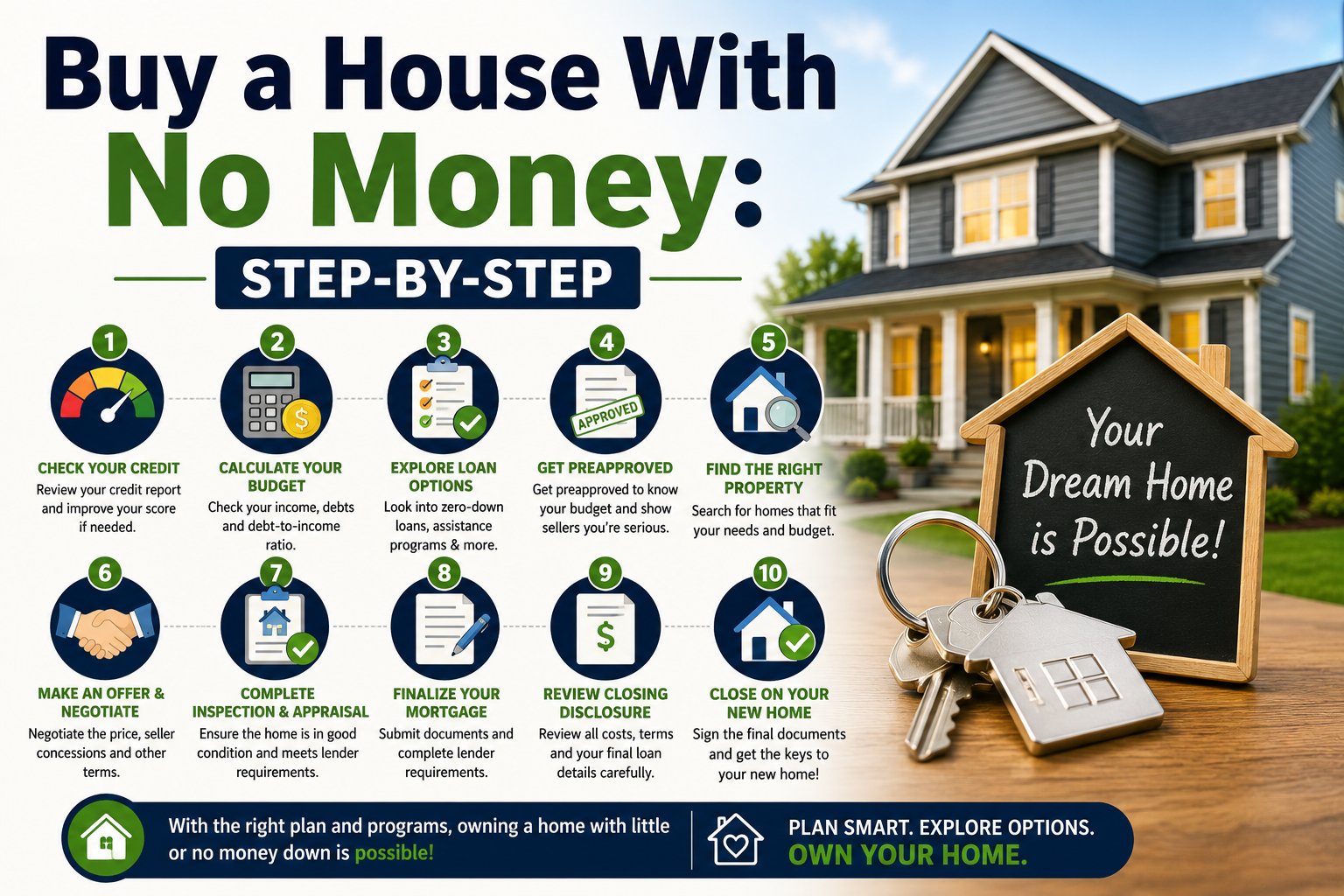
If your goal is to buy a home with little or no cash, follow this process.
Step 1: Check your credit
Review your credit reports and credit scores. Correct errors and avoid taking on unnecessary new debt before applying for a mortgage.
Step 2: Calculate your debt-to-income ratio
Lenders consider your income and existing debts when determining how much mortgage you can afford.
Step 3: Determine which loan programs you qualify for
Ask lenders about:
- VA loans
- USDA loans
- FHA loans
- Conventional 3% down programs
- State down payment assistance
- Local first-time buyer programs
Step 4: Get mortgage preapproval
A preapproval can give you a clearer idea of your purchasing budget and make your offer more credible.
Step 5: Search for affordable properties
Use online real estate listings to compare houses by:
- Price
- Location
- Bedrooms
- Property type
- Taxes
- HOA fees
- Estimated monthly payment
You can also explore property listings on ZameenInfo.com to discover real estate opportunities and compare available properties.
Step 6: Negotiate the purchase
Depending on the market, your agent may negotiate:
- Purchase price
- Seller concessions
- Repairs
- Closing date
- Other contract terms
Step 7: Complete inspection and appraisal
Don’t skip due diligence just because you are trying to minimize upfront costs.
Step 8: Finalize your mortgage
Your lender will verify your income, assets, debts, credit, property information, and other documentation.
Step 9: Review your Closing Disclosure
Before closing, carefully review your loan terms and closing costs.
Step 10: Close on the home
Once all requirements are satisfied, you sign the final documents and become the homeowner.
How Much Money Do You Really Need to Buy a House?
The amount of cash needed varies dramatically depending on your mortgage and assistance programs.
Consider a hypothetical $300,000 home:
| Financing option | Example down payment |
|---|---|
| VA loan | $0 if eligible |
| USDA loan | $0 if eligible |
| 3% conventional loan | $9,000 |
| FHA 3.5% down | $10,500 |
| 5% down | $15,000 |
| 10% down | $30,000 |
| 20% down | $60,000 |
These figures are examples only and do not include closing costs or other expenses.
The key point is that you don’t necessarily need $60,000 to buy a $300,000 home. Depending on your eligibility, financing and assistance options may allow you to buy with substantially less upfront cash.
Can You Buy a House With Bad Credit and No Money?
It can be difficult, but having limited savings or imperfect credit doesn’t automatically mean you cannot become a homeowner.
Your options may include:
- FHA financing
- Down payment assistance
- Credit improvement before buying
- A co-borrower
- Gift funds
- Local first-time homebuyer programs
- Lower-priced properties
However, lenders still evaluate your ability to repay the mortgage.
If your credit is weak, don’t focus only on finding a lender willing to approve you. Also compare the interest rate, mortgage insurance, fees, and total cost of borrowing.
A slightly higher approval amount can become expensive if the mortgage payment is unaffordable.
What Does “No Money Down” Actually Mean?
When people search for “how to buy a house with no money,” they often mean one of two things:
No down payment
You don’t pay a traditional percentage of the purchase price upfront.
VA and USDA financing can potentially accomplish this for qualifying borrowers.
No cash to close
You have little or no personal cash available for the entire transaction.
This is harder because you may still have closing costs, prepaid expenses, inspections, earnest money, and other costs.
To reduce cash needed at closing, buyers may potentially combine:
Zero/low-down financing + down payment assistance + seller concessions + eligible gift funds
The exact combination depends on the mortgage program and lender rules.
Common Mistakes to Avoid When Buying a House With No Money
Trying to minimize upfront costs can be useful, but don’t make these mistakes.
1. Buying more house than you can afford
A $0 down payment doesn’t mean a $0 monthly payment.
You still need to pay the mortgage, property taxes, homeowners insurance, utilities, maintenance and potentially HOA fees.
2. Ignoring closing costs
Always ask your lender for a complete estimate of your cash-to-close amount.
3. Using expensive personal loans for the down payment
Borrowing money at a high interest rate can create additional debt and may violate mortgage program rules if not properly disclosed and permitted.
4. Skipping the home inspection
Saving money upfront can result in much larger repair costs later.
5. Choosing a mortgage based only on the down payment
A mortgage with a smaller down payment can sometimes have higher ongoing costs.
Compare the APR, interest rate, mortgage insurance, fees, monthly payment and total estimated cost.
6. Assuming every “government home grant” is legitimate
Be careful with websites promising guaranteed government money or instant homeownership. Verify programs through official government agencies or reputable housing organizations.
Frequently Asked Questions
Can I really buy a house with $0 down?
Yes. Some eligible buyers can purchase homes with no down payment through programs such as VA and USDA financing. Eligibility and property requirements apply.
What is the easiest way to buy a house with no money down?
For eligible borrowers, a VA loan or USDA loan may provide a path to zero-down financing. Buyers who don’t qualify can investigate down payment assistance and low-down-payment mortgages.
Can first-time homebuyers buy a house with no money?
Potentially. First-time buyers may qualify for state, local or nonprofit assistance programs, and some mortgage programs have low down payment requirements.
Can I buy a house with no money and bad credit?
It may be possible, but approval depends on the mortgage program, lender requirements, income, debts, credit history and other factors. Improving your credit before applying may increase your options.
Can I use a gift for my down payment?
Some mortgage programs permit eligible gift funds for down payments and closing costs. The money must meet the applicable lender and program requirements.
What credit score do I need to buy a house?
There is no single credit score that applies to every mortgage. Requirements vary by loan type and lender. Some programs may have more flexible credit requirements than others.
Can I buy a house without a 20% down payment?
Yes. Many homebuyers purchase properties with significantly less than 20% down. Some programs allow 3% or 3.5% down, while VA and USDA financing can potentially require 0% down for qualifying borrowers.
Is buying a house with no money a good idea?
It can be a good strategy when the buyer has stable income, can afford the monthly payment and qualifies for a suitable program. However, homeowners should ideally maintain emergency savings even if their mortgage requires little or no down payment.
Final Thoughts
Buying a house with no money down is possible for some homebuyers in the USA, but it requires the right financing strategy and eligibility.
If you’re eligible for a VA or USDA loan, you may be able to purchase a home with 0% down. Other buyers can explore FHA loans, 3% down conventional mortgages, down payment assistance, seller concessions and eligible gift funds to reduce the amount of cash needed upfront.
The smartest approach is not simply finding a mortgage with the lowest down payment. Instead, compare the total cost of the home, monthly payment, interest rate, mortgage insurance, closing costs and your long-term financial position.
Before making an offer, speak with multiple lenders and ask specifically about zero-down programs, first-time homebuyer assistance and local down payment assistance.