

 by Amir Iqbal
What Is an Intellectual Property Lawyer?
An intellectual property lawyer is an attorney who helps individuals and businesses protect, manage, enforce, and defend valuable creations of the mind. These creations can include inventions, brand names, logos, software, artistic works, designs, confidential business information, and other intellectual assets.
Intellectual property, commonly called IP, generally includes four major areas: patents, trademarks, copyrights, and trade secrets. Federal law plays a major role in patent and copyright protection, while trademark rights can involve both federal and state law. Trade secret protection is primarily governed by applicable state and federal laws.
For example, a technology company may need a patent lawyer to protect an invention, a trademark lawyer to protect its brand name, and a copyright lawyer to protect website content or software.
Because intellectual property can represent a significant part of a company’s value, working with the right legal professional can help prevent costly disputes and protect business opportunities.
What Does an Intellectual Property Lawyer Do?
The work of an intellectual property lawyer depends on the type of IP involved and the client’s goals. Some attorneys focus on registration and protection, while others concentrate on licensing, transactions, or litigation.
Common responsibilities include:
- Filing and managing patent applications
- Trademark searches and trademark registration
- Copyright registration and protection
- Protecting trade secrets and confidential information
- Drafting intellectual property agreements
- Negotiating licensing agreements
- Handling IP ownership disputes
- Sending cease-and-desist letters
- Defending clients accused of infringement
- Representing clients in intellectual property litigation
- Conducting IP due diligence during business transactions
- Advising startups and companies about intellectual property strategy
An IP lawyer may also help determine which type of protection is most appropriate for a particular asset.
For example, a company logo is generally associated with trademark protection, while an original photograph may receive copyright protection. An invention may qualify for patent protection, while confidential formulas or business information may be protected as trade secrets.
Types of Intellectual Property Lawyers
Not every intellectual property lawyer handles the same type of work. When searching for an attorney, it is important to understand the main areas of IP law.
1. Patent Lawyer
A patent lawyer helps clients protect inventions and technologies.
Patent-related legal services can include:
- Patent searches
- Patentability opinions
- Patent applications
- Patent prosecution
- Patent licensing
- Patent infringement disputes
- Patent litigation
- Technology transactions
Patent law can be particularly important for technology companies, pharmaceutical businesses, engineers, manufacturers, and inventors.
Some attorneys also have technical or scientific backgrounds, which can be useful when dealing with complex inventions.
2. Trademark Lawyer
A trademark lawyer helps businesses protect names, logos, slogans, symbols, and other brand identifiers.
Typical trademark services include:
- Trademark searches
- Trademark clearance
- Trademark applications
- Trademark registration
- Trademark monitoring
- Trademark licensing
- Trademark infringement disputes
- Trademark opposition and cancellation matters
A registered trademark can provide important legal benefits, but trademark protection is a specialized area, so businesses should consider professional legal advice before investing heavily in a brand.
3. Copyright Lawyer
Copyright lawyers deal with original creative works.
These may include:
- Books
- Music
- Photography
- Videos
- Artwork
- Software
- Website content
- Graphic designs
- Digital media
Copyright protection generally arises automatically when an original work is fixed in a tangible form, although registration with the U.S. Copyright Office can provide important benefits.
4. Trade Secret Lawyer
Trade secrets can include confidential information that provides a business advantage.
Examples include:
- Customer lists
- Manufacturing processes
- Formulas
- Business strategies
- Proprietary software information
- Internal pricing information
Unlike patents and trademarks, trade secrets are not registered through a government application. Businesses generally need reasonable measures to maintain secrecy.
When Should You Hire an Intellectual Property Lawyer?
You may want to speak with an intellectual property lawyer when your business or personal work involves valuable intellectual assets.
Common situations include:
You Are Starting a Business
Before launching a new company, an IP lawyer can help you evaluate your business name, logo, product, technology, content, and other intellectual property.
You Created a New Invention
If you have developed a potentially patentable invention, professional advice can help you understand your options before publicly disclosing the invention.
You Are Launching a Brand
A trademark lawyer can help you investigate whether a proposed business name, product name, or logo may conflict with existing trademarks.
Someone Is Using Your Work
If another company or individual is using your copyrighted work, trademark, invention, or other protected IP without authorization, an attorney can explain possible enforcement options.
You Are Buying or Selling a Business
Intellectual property can be a major part of a company’s value. Lawyers can conduct IP due diligence and help review ownership, licensing, registration, and potential disputes.
You Need an IP Licensing Agreement
If you want another company to use your invention, software, brand, content, or technology, an IP lawyer can help negotiate and draft appropriate licensing terms.
Intellectual Property Lawyer New York

New York is one of the major U.S. markets for intellectual property law because of its large technology, media, entertainment, advertising, finance, fashion, publishing, and startup industries.
If you are searching for an intellectual property lawyer New York, consider looking for an attorney with experience specifically related to your type of IP.
For example:
- Technology startups may need patent and software IP experience.
- Fashion businesses may need trademark and design protection.
- Media companies may need copyright and licensing expertise.
- E-commerce businesses may need trademark, copyright, and online infringement assistance.
- Inventors may need patent prosecution and licensing experience.
The New York City Bar explains that intellectual property can cover inventions, creative works, brand identifiers, and valuable confidential business information.
When comparing lawyers in New York, look beyond general legal experience. Ask about their experience with cases and transactions similar to yours.
Intellectual Property Lawyer NYC
People searching for an intellectual property lawyer NYC are often looking for attorneys who understand the legal and commercial environment of New York City.
NYC has a particularly broad IP ecosystem involving:
- Technology companies
- Startups
- Financial services
- Fashion brands
- Advertising agencies
- Entertainment companies
- Publishers
- Software companies
- E-commerce businesses
- Creative professionals
An NYC intellectual property lawyer may assist with everything from trademark registration and copyright matters to patent disputes, licensing agreements, and IP litigation.
The NYC Bar’s Legal Referral Service provides information about intellectual property law and lawyer referrals in New York City.
How to Choose an IP Lawyer in NYC
Before hiring an attorney, consider asking:
- What type of intellectual property law do you specialize in?
- Have you handled cases similar to mine?
- Do you work with individuals, startups, or larger companies?
- Do you handle registration as well as litigation?
- What are your legal fees?
- Will you personally handle my case?
- What potential risks should I know about?
- What documents should I provide for an initial consultation?
Choosing an attorney based on the specific legal problem can be more useful than choosing solely based on location.
How Much Does an Intellectual Property Lawyer Cost?
The cost of an intellectual property lawyer can vary considerably depending on the type of legal work, attorney experience, location, complexity of the matter, and billing structure.
Some lawyers charge hourly rates, while others may offer fixed fees for specific services such as certain trademark or copyright filings.
More complicated matters, such as patent prosecution or IP litigation, can require substantially more legal work.
Before hiring an attorney, ask for an explanation of:
- Hourly rates
- Flat fees
- Retainers
- Filing fees
- Litigation expenses
- Expert fees
- Other potential costs
Do not select an attorney based only on the lowest price. The potential commercial value of the intellectual property and the complexity of the legal issue should also be considered.
Intellectual Property Lawyer Salary
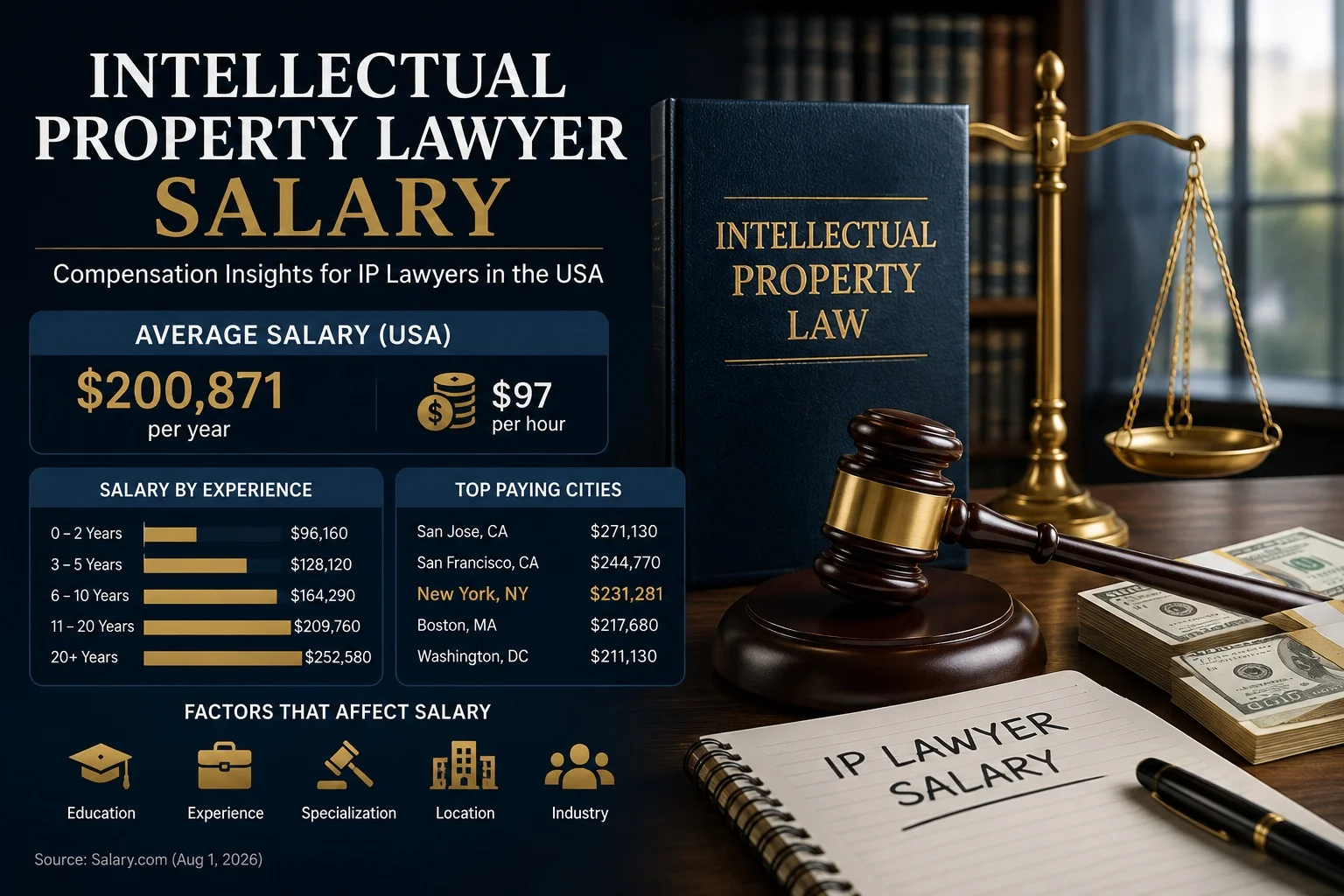
Another popular search related to this profession is intellectual property lawyer salary.
IP lawyers can earn significantly different salaries depending on experience, geographic location, employer, technical background, specialization, and whether they work at a law firm, corporation, government agency, or another organization.
According to Salary.com, as of August 1, 2026, the average U.S. salary for an intellectual property lawyer was approximately $200,871 per year, or about $97 per hour. Its reported 25th–75th percentile range was approximately $185,392 to $216,901, while the 90th percentile was approximately $231,495.
Intellectual Property Lawyer Salary in New York
New York compensation can be higher than the national figure.
Salary.com reported that as of August 1, 2026, the average intellectual property lawyer salary in New York, NY was approximately $231,281 per year, or around $111 per hour. Its reported 25th–75th percentile range was approximately $213,458 to $249,738.
Salary figures should be treated as estimates rather than guaranteed compensation. Actual pay can differ substantially based on experience, employer, practice area, billable workload, technical expertise, and other factors.
For law firm associates, compensation can also be considerably different from broader salary estimates. NALP’s 2025 Associate Salary Survey, for example, reported high associate compensation levels for intellectual property practices, with salaries increasing substantially by seniority.
How to Become an Intellectual Property Lawyer
Becoming an intellectual property lawyer generally requires completing legal education and meeting the requirements to practice law in the relevant U.S. jurisdiction.
A typical path includes:
Step 1: Earn a Bachelor’s Degree
Students generally complete an undergraduate degree before attending law school.
For patent-focused careers, a background in science, engineering, computer science, or another technical discipline can be particularly useful.
Step 2: Attend Law School
Students typically earn a Juris Doctor (JD) degree from an accredited law school.
Courses related to IP can include:
- Patent law
- Trademark law
- Copyright law
- Trade secrets
- Technology law
- Intellectual property litigation
- Licensing
Step 3: Pass the Bar Exam
After law school, candidates must satisfy the licensing requirements of the jurisdiction where they intend to practice.
Step 4: Develop IP Experience
New lawyers can build experience through law firms, corporate legal departments, government agencies, internships, clerkships, or specialized IP practices.
Step 5: Consider Patent Practice
Lawyers who want to practice before the USPTO in patent matters may need to meet additional requirements and pass the USPTO registration examination.
Intellectual Property Lawyer vs. Patent Attorney
The terms “intellectual property lawyer” and “patent attorney” are sometimes used interchangeably, but they can describe different areas of practice.
An intellectual property lawyer may work across multiple areas, including:
- Trademarks
- Copyrights
- Patents
- Trade secrets
- Licensing
- IP litigation
A patent attorney generally focuses heavily on patent matters and may be registered to practice before the USPTO in patent cases.
If your legal problem involves an invention, ask whether the attorney has the technical background and USPTO registration necessary for your particular matter.
What Questions Should You Ask an Intellectual Property Lawyer?
A consultation can help you determine whether an attorney is appropriate for your situation.
Consider asking:
Do you specialize in my type of intellectual property?
A lawyer who primarily handles trademarks may not be the best choice for a complex patent dispute.
Have you handled similar cases?
Relevant experience can be more valuable than general years of practice.
What are the expected costs?
Ask whether the matter will be billed hourly or through a fixed-fee arrangement.
What are my legal options?
A good consultation should help you understand the available paths and potential risks.
How long could the process take?
The timeline depends heavily on the type of IP matter.
How to Find the Best Intellectual Property Lawyer for Your Needs
There is no single “best” intellectual property lawyer for every client.
Instead, look for an attorney who matches your particular legal needs.
Consider These Factors
Specialization:
Choose someone experienced in the specific area of IP involved.
Experience:
Look for experience with matters similar to yours.
Location:
If your matter involves local proceedings or a New York business, a lawyer familiar with the relevant jurisdiction may be useful.
Industry knowledge:
Technology, fashion, entertainment, pharmaceuticals, software, and e-commerce businesses can have very different IP concerns.
Communication:
Your lawyer should explain complex legal issues clearly.
Fees:
Understand the fee structure before hiring.
Professional reputation:
Check reliable professional directories, bar associations, and other trustworthy sources.
FAQs
What is an intellectual property lawyer?
An intellectual property lawyer is an attorney who helps clients protect, enforce, manage, license, and defend intellectual property such as patents, trademarks, copyrights, and trade secrets.
What does an intellectual property lawyer do?
An IP lawyer can handle registration, licensing, contracts, disputes, infringement claims, IP transactions, and litigation depending on their practice area.
How much does an intellectual property lawyer make?
Salary varies by location and experience. Salary.com reported a U.S. average of about $200,871 per year for an intellectual property lawyer as of August 1, 2026.
How much does an intellectual property lawyer make in New York?
Salary.com reported an average of approximately $231,281 per year for an intellectual property lawyer in New York, NY as of August 1, 2026.
Do I need an intellectual property lawyer to register a trademark?
Not necessarily. Individuals and businesses can pursue trademark registration themselves, but an experienced attorney can help identify potential conflicts, navigate legal requirements, and reduce avoidable mistakes.
Do I need a lawyer for a patent?
You are not always legally required to hire an attorney, but patent applications can be technically and legally complex. An experienced patent professional can help with patent strategy, preparation, prosecution, and related issues.
What is the difference between copyright and trademark?
Copyright generally protects original creative works, while trademarks identify and distinguish the source of goods or services.
Can an intellectual property lawyer help with online infringement?
Yes. Depending on the circumstances, an IP lawyer may help with unauthorized use of copyrighted content, trademarks, software, images, branding, or other protected material.
Final Thoughts
An intellectual property lawyer can help protect some of the most valuable assets owned by an individual or business. Whether you need assistance with a patent, trademark, copyright, trade secret, licensing agreement, or infringement dispute, the right legal professional can help you understand your options.
If you are specifically searching for an intellectual property lawyer New York or an intellectual property lawyer NYC, focus on attorneys who have experience with your particular industry and legal issue rather than choosing solely based on location.
For people researching the profession itself, the intellectual property lawyer salary can be attractive, particularly in major legal markets such as New York. However, compensation varies significantly by experience, specialization, employer, and location.