

 by Amir Iqbal
If you own or plan to buy a home, condo, or commercial property anywhere from Clearwater to St. Petersburg, the Pinellas County Property Appraiser is the office that determines what your property is worth for tax purposes, tracks your exemptions, and publishes the free public records tool most people mean when they search “Pinellas County property tax search.” This guide answers the questions people actually type into Google who runs the office, how Pinellas county Florida property appraiser calculates your assessed value, whether you need to refile your Homestead Exemption every year, and how to search property tax records in one place.
Who Is the Pinellas County Property Appraiser?
The current Pinellas County Property Appraiser is Mike Twitty, MAI, CFA. Twitty was sworn into office on January 3, 2017, and is a lifelong Pinellas County resident who grew up in Largo. Before being elected, he spent over 30 years in the private appraisal industry, working his way up to senior managing director and principal of a residential and commercial appraisal firm based in the county.
Twitty holds several notable professional credentials:
- MAI designation from the Appraisal Institute, one of the most respected credentials in commercial real estate valuation
- Certified Florida Appraiser (CFA) designation from the Florida Department of Revenue
- Florida Real Estate Broker’s license and State-Certified General Real Estate Appraisal certification
Beyond his day job, Twitty is active in state-level property appraisal policy. He chairs the pinellas county florida property appraiser Legislative Committee, serves as a District Director for the Florida Association of Property Appraisers (FAPA), and was appointed to the Board of Trustees of The Appraisal Foundation. Locally, he chairs the Enterprise GIS (eGIS) Steering Committee for Pinellas County government and sits on the Business Technology Services Board.
What the Property Appraiser’s Office Actually Does
The Pinellas County Property Appraiser is a constitutional office, separate from the Tax Collector and the Board of County Commissioners. Its core job is valuation and exemption administration, not tax collection. Specifically, the office:
- Appraises the market value of more than 435,000–450,000 parcels across Pinellas County every year, covering 24 cities plus unincorporated areas
- Reviews and approves Homestead Exemption and other exemption applications
- Maintains the public property database (ownership, sales history, building characteristics, GIS maps)
- Mails the annual TRIM (Truth in Millage) Notice in August
- Administers the Save Our Homes assessed-value cap and portability transfers
- Represents the county at Value Adjustment Board (VAB) hearings when owners appeal their assessed value
Importantly, the Property Appraiser does not set your tax rate and does not send your tax bill. Millage rates are set independently by taxing authorities — the county commission, school board, individual cities, and special districts and the actual bill is mailed and collected by the Pinellas County Tax Collector, a separate elected office.
Pinellas County Property Tax Search: How to Look Up a Property
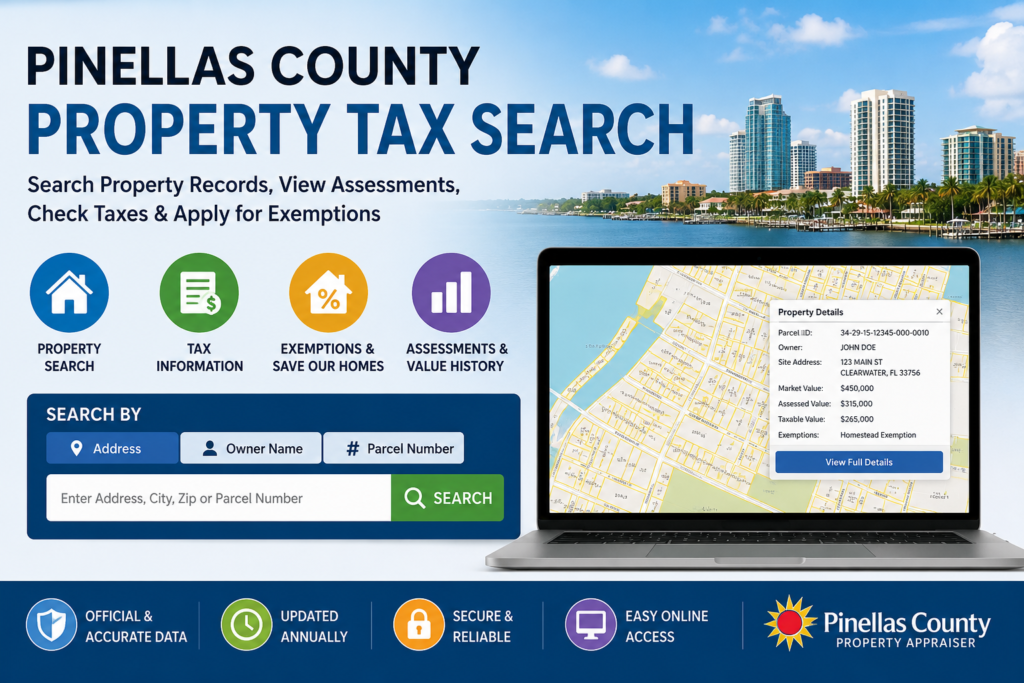
Most people arrive at the Property Appraiser’s website looking for one of two things: what a property is worth or whether it has a Homestead Exemption on file. Both are available for free through the office’s online search tools no login or fee required.
Step-by-Step: Doing a Property Search
- Go to the official search tool. Use the Quick Search or Advanced Search feature on pcpao.gov rather than a third-party lookup site, since third-party sites often display outdated or incomplete data.
- Choose your search method. You can search by:
- Owner name
- Property address
- Parcel ID / Parcel Number (the most precise, single-record method)
- Subdivision or neighborhood code
- Open the parcel detail page. This shows Just Value, Assessed Value / Save Our Homes cap, exemption status, land value, building characteristics, sales history, and the Tax District/millage code.
- Check the Homestead column. If it reads “Yes” for the current year, an exemption is active on that parcel.
- Pull the TRIM Notice or tax documents. From the parcel page, open the “Tools” tab and select the TRIM Notice option to view the current Notice of Proposed Property Taxes.
- For actual bills and payment status, switch to the Pinellas County Tax Collector website — the Property Appraiser’s site shows valuation, not billing or payment history.
What You’ll Find on a Property Record
A typical parcel record includes:
- Owner name(s) as legally recorded
- Parcel ID — the unique identifier used for tax and legal purposes
- Property address and ZIP code
- Property Use Code (residential, commercial, vacant, etc.)
- Legal description (subdivision, lot, block)
- Land value and total assessed/taxable value
- Tax District, which determines which millage rates apply
- Exemption status, including Homestead, Senior, Veteran, or Disability exemptions
- Sales history and building characteristics (square footage, year built, etc.)
This information is public record under Florida’s Government-in-the-Sunshine laws, though confidential data like Social Security numbers is protected and never disclosed.
How Does Florida Assess Property Value?
Florida’s property assessment system runs on a specific sequence set by state law and the Florida Constitution. Understanding each step explains why your tax bill may not track your home’s actual sale price.
Step 1: Just Value (Market Value)
Every January 1, the Property Appraiser establishes the Just Value — essentially the market value — of every parcel in the county. To do this, appraisers analyze:
- Recent sales of comparable properties
- Physical characteristics: size, age, condition, construction quality
- Location and neighborhood factors
- Improvements or renovations
- For income-producing property, rental income and operating expenses
This is a mass appraisal process, meaning the office values hundreds of thousands of parcels using standardized models rather than individual walk-through appraisals for every home, though on-site review does occur for specific properties, permits, or appeals.
Step 2: Assessed Value and the Save Our Homes Cap
For most properties, Assessed Value equals Just Value. But for homesteaded properties, Florida’s Save Our Homes (SOH) amendment — approved by voters in 1992 as part of Article VII, Section 4 of the Florida Constitution — limits how much the Assessed Value can increase each year, even if the market value rises faster.
- The annual increase in Assessed Value is capped at 3%, or the change in the Consumer Price Index (CPI), whichever is lower.
- This cap only begins the year after a Homestead Exemption is granted.
- The cap resets when a homesteaded property is sold — the new owner’s Assessed Value reverts to that year’s Just Value before their own exemption and cap begin accumulating.
- Owners who sell a homesteaded property and buy another Florida homestead can transfer, or “port,” some or all of their accumulated Save Our Homes benefit to the new property, up to $500,000, through Homestead Portability.
Non-homesteaded residential and commercial property has its own, separate 10% annual assessment cap under Florida law, though that cap resets on transfer of ownership as well.
Step 3: Exemptions
Once Assessed Value is set, qualifying exemptions are subtracted to arrive at Taxable Value. Common exemptions in Pinellas County include:
| Exemption | Benefit | Notes |
|---|---|---|
| Homestead Exemption | Up to $50,000 off assessed value | First $25,000 applies to all levies; second $25,000 (on value between $50,000–$75,000) excludes school taxes |
| Additional Senior Exemption (65+) | Varies by income limit and municipality | Requires household income documentation |
| Total & Permanent Disability | Can exempt full value for qualifying quadriplegics | Requires physician certification |
| Disabled Veteran Exemptions | Partial to full exemption depending on disability rating | Requires VA documentation |
| Widow/Widower Exemption | $5,000 off assessed value | Available to any permanent Florida resident |
Step 4: Millage Rate and Final Tax Bill
Taxable Value is multiplied by the combined millage rate for your specific Tax District to calculate the tax owed. A mill equals $1 of tax per $1,000 of taxable value. Your millage rate is a blend set by several independent taxing authorities:
- Pinellas County Board of County Commissioners
- The Pinellas County School Board
- Your municipality (if you live inside a city)
- Special districts (water management, fire, recreation districts, etc.)
Combined millage rates across Pinellas County generally produce an effective property tax rate of roughly 1.0% to 1.26% of assessed value, though this varies by city and taxing district. St. Petersburg, for example, carries a combined millage rate in the range of 16–17 mills depending on the year and specific district.
Does Homestead Exemption Have to Be Filed Every Year in Florida?
This is one of the most searched questions about Florida property taxes, and the short answer is no — but with important exceptions.
Automatic Renewal
Once your Homestead Exemption is approved, Florida law (Section 196.011, Florida Statutes) allows it to automatically renew each year on January 1, as long as:
- Ownership of the property has not changed
- The manner in which title is held has not changed
- You still use the property as your permanent, primary residence
- Your eligibility status (e.g., income for a senior exemption) hasn’t changed in a way that affects it
Each January, the Property Appraiser mails a renewal receipt (often a pink and white card) confirming the exemption carried over automatically. If nothing has changed, you simply keep the card — there’s no form to resubmit and no fee.
When You DO Need to File a New Application
You must submit a new Homestead Exemption application (Form DR-501) by March 1 of the relevant tax year if any of the following occur:
- You purchase a new home and move
- You add or remove an owner from the deed
- You place the property into a trust (this counts as a title change)
- You get married, divorced, or a spouse passes away, changing how title is held
- An heir inherits a previously homesteaded property and now holds title in their own name
Deadline: Applications must be filed by March 1 of the tax year for which you’re claiming the exemption. Under Florida law, missing that deadline is treated as a waiver of the exemption for that year you’d have to wait and apply again the following year. Some late filings are accepted through a Value Adjustment Board hearing in cases of documented extenuating circumstances, such as serious illness or a natural disaster.
Your Ongoing Responsibility
Even though renewal is automatic, Florida law places the burden on the property owner to notify the Property Appraiser if they no longer qualify — for example, if they move out, start renting the home, or establish residency elsewhere. Failing to report a disqualifying change can result in back taxes, a 50% penalty, and 15% annual interest under Florida Statute 196.161. The Property Appraiser’s office also runs its own data analysis to identify potentially improper exemptions, so it’s worth double-checking your TRIM Notice every August to confirm your exemption still appears.
Homestead Exemption Quick Facts
- Save Our Homes limits future assessed value increases to 3% (or CPI, if lower) starting the year after approval
- You can only claim a homestead exemption on one property, in Florida or anywhere else
- Portability lets you transfer accumulated SOH savings to a new Florida homestead — but this requires a separate portability application, also due March 1
- A partial exemption may apply if you own less than 100% of the property
The TRIM Notice and How to Appeal Your Assessment
Every August, the Property Appraiser mails the Truth in Millage (TRIM) Notice — sometimes called the Notice of Proposed Property Taxes. This is not a bill; it’s a preview showing your current and prior-year taxable value, your exemptions, and the proposed millage rates from each taxing authority, alongside each authority’s public budget hearing dates.
If you believe your assessed value doesn’t reflect fair market value, you have two main options:
- Informal review: Contact the appraiser assigned to your area (listed on the TRIM Notice) to discuss the valuation directly. Many disagreements are resolved this way without a formal appeal.
- Formal appeal to the Value Adjustment Board (VAB): File a petition within 25 days of the TRIM Notice mailing date. Bring supporting evidence comparable sales, independent appraisals, or documentation of property condition. A Special Magistrate reviews the evidence and recommends a decision to the board; the VAB’s ruling is final.
Actual tax bills are mailed by the Tax Collector around November 1, are payable through March 31, and become delinquent on April 1. Early payment discounts typically apply for bills paid in November through February.
Portability in Practice: A Simple Example
Portability confuses more homeowners than any other part of the Save Our Homes system, so it helps to see it worked through with numbers.
Say a homeowner’s previous house had a Just Value of $400,000 but, thanks to years of the 3% Save Our Homes cap, an Assessed Value of only $250,000. That’s a $150,000 Save Our Homes benefit. If they sell that home and buy a new one in Pinellas County with a Just Value of $500,000, portability lets them subtract up to that $150,000 benefit from the new home’s Just Value, producing a starting Assessed Value of roughly $350,000 instead of the full $500,000 — before their new Homestead Exemption is even applied.
A few rules govern this:
- You must establish the new homestead within three tax years of abandoning the prior one (this window was expanded from two to three years effective January 1, 2021).
- Portability is capped at a maximum transferable benefit of $500,000.
- It requires its own separate application, filed alongside — not instead of — your new Homestead Exemption application, and both are due by March 1.
- Downsizing to a less expensive home still lets you port a proportional share of the benefit; upsizing lets you port the full dollar amount.
Tangible Personal Property Tax: A Separate Filing Business Owners Must Know
Homeowners aren’t the only ones with an annual filing obligation tied to the Property Appraiser’s office. Any business that owns or leases Tangible Personal Property — furniture, fixtures, equipment, tools, machinery, and similar movable business assets used in a commercial setting — in Pinellas County must file a TPP Tax Return by April 1 each year, separate from and unrelated to the Homestead Exemption process. Unlike Homestead, TPP returns generally must be filed annually rather than renewing automatically, though many jurisdictions offer an exemption on the first $25,000 of assessed TPP value for qualifying businesses. Late TPP filings can trigger penalties, so business owners should treat April 1 as a hard deadline distinct from the March 1 homestead cutoff.
Non-Ad Valorem Assessments: The Other Line on Your Bill
Not every charge on a Pinellas County tax bill comes from the Just Value/millage rate formula described above. Non-ad valorem assessments are flat or formula-based fees tied to a specific benefit a property receives — stormwater/surface water management, solid waste collection, street lighting, or municipal improvement districts, for example — rather than to the property’s market value. These assessments are:
- Set by the individual city, county division, or special district providing the service, not by the Property Appraiser
- Certified and added to the annual bill by the Tax Collector, alongside the ad valorem (value-based) taxes
- Payable in the same November–March window as regular property taxes, and eligible for the same early-payment discounts
- Sometimes payable in a lump sum before the tax roll certifies in September, which can avoid financing interest if the assessment was issued for a completed public improvement project
If your annual tax bill looks higher than a millage-rate calculation alone would suggest, a non-ad valorem assessment for services like surface water management is the most common explanation.
Pinellas County vs. Neighboring Counties: How the Process Compares
Property owners moving within the Tampa Bay area often ask whether Pinellas works differently from Hillsborough, Pasco, or other nearby counties. The short answer: the underlying state law is identical everywhere in Florida — Just Value, Save Our Homes, the March 1 homestead deadline, and the TRIM notice process are all set by the Florida Constitution and Florida Statutes, not by individual counties. What differs county to county is:
- The specific millage rates, which are set locally and vary based on each county’s and municipality’s budget needs
- The look and navigation of each county’s property search portal (though all Florida property appraiser offices provide a free public search tool)
- Local non-ad valorem assessments, which are unique to each jurisdiction’s service districts
- Processing times and in-person office locations for exemption applications
This is useful context for anyone comparing a move between, say, Pinellas and Hillsborough County — the rules of the game stay the same, but the rates and local fees will differ.
Key Takeaways
- Mike Twitty, MAI, CFA has served as the elected Pinellas County Property Appraiser since January 2017 and oversees valuation of more than 435,000 parcels annually.
- Homestead Exemption renews automatically each year in Florida as long as ownership and residency stay the same — you only need to refile after a title change, move, or ownership event, and always by March 1.
- Florida assesses property in stages: Just Value Assessed Value (with Save Our Homes cap for homesteaded property) → Taxable Value (after exemptions) final tax bill (Taxable Value × millage rate).
- Property tax search and property value lookups in Pinellas County are free through the Property Appraiser’s official Quick Search and Advanced Search tools while actual bills and payment status come from the separate Tax Collector’s office.
- Watch for your TRIM Notice each August — it’s your primary window to catch valuation issues or appeal to the Value Adjustment Board before tax bills are finalized in November.
FAQS About Pinellas County Property Appraiser
Who is the appraiser for Pinellas County?
The current Pinellas County Property Appraiser is Mike Twitty, responsible for property valuation, exemptions, and maintaining county property records.
Does a Homestead Exemption have to be filed every year in Florida?
No. After approval, it generally renews automatically as long as the homeowner continues to qualify and the property remains their permanent residence.
How does Florida assess property value?
Florida assesses property based on fair market value using factors such as comparable sales, property characteristics, location, and applicable legal assessment limits.
What is taxable value?
Taxable value is the amount remaining after deductions, exemptions, and assessment limits are applied to the assessed value.
Can I search property taxes online?
Yes. Property owners can search online using an address, owner name, or parcel number to view assessment details, exemptions, and tax information.
How often are property values updated?
Property values are generally reviewed and updated annually according to Florida law.
What is the Save Our Homes benefit?
It limits annual increases in the assessed value of qualifying homesteaded properties, helping reduce future property tax growth.