
 by Amir Iqbal
How to Rent an Apartment in the USA can feel confusing when you are doing it for the first time. You may see a great listing online, but then the landlord asks for income proof, credit history, references, application fees, security deposit, renters’ insurance, and a signed lease. For a beginner, this can quickly become stressful.
The good news is that the apartment rental process in the USA becomes much easier when you understand each step before you start applying. Whether you are moving to New York, Los Angeles, Chicago, Houston, Dallas, Atlanta, Miami, Phoenix, Boston, Seattle, or a smaller U.S. city, the basic process is usually similar: set your budget, search carefully, prepare your documents, tour the apartment, submit an application, pass screening, sign the lease, pay move-in costs, and complete your move-in checklist.
This guide explains how to rent an apartment step by step, especially for first-time renters in the United States.
1. Decide How Much Rent You Can Afford
Before renting an apartment, calculate your monthly budget. A common rule is to keep rent around 30% of your gross monthly income, but this is only a starting point. You also need to consider utilities, internet, parking, renters’ insurance, groceries, transportation, student loans, credit card payments, and savings.
For example, if you earn $20 per hour and work 40 hours per week, your estimated gross monthly income is about $3,467. Thirty percent of that is about $1,040. In that case, a $1,000 apartment may be possible on paper, but you should still check your real take-home pay after taxes and your other expenses.
Many U.S. landlords also use an income requirement, such as earning 2.5 to 3 times the monthly rent. If the apartment rent is $1,500, the landlord may want to see a monthly income of $3,750 to $4,500. If your income is lower, you may need a roommate, co-signer, guarantor, or cheaper apartment.
2. Choose the Right City, Neighborhood, and Apartment Type
The next step is deciding where you want to live. In the USA, rent can change dramatically from one city to another and even from one neighborhood to the next. A one-bedroom apartment in Manhattan, San Francisco, or Los Angeles may cost much more than a similar apartment in a smaller city or suburban area.
When comparing locations, think about more than rent. Look at commute time, public transportation, parking, grocery stores, schools, hospitals, safety, noise, walkability, and distance from work or college. A cheaper apartment far away from your job may not actually save money if your transportation costs increase.
Then decide what type of apartment you need. Common options include studio apartments, one-bedroom apartments, two-bedroom apartments, furnished apartments, student apartments, luxury apartments, and shared apartments. Make a list of “must-haves” and “nice-to-haves.” For example, air conditioning, laundry, parking, pet-friendly rules, elevator access, and internet availability may matter more than a gym or pool.
3. Start Apartment Hunting Online and Offline
Once your budget and location are clear, start searching. You can use rental websites, property management websites, local real estate agents, Facebook groups, university housing boards, and “For Rent” signs in neighborhoods. Apartment hunting tips for beginners include saving listings, comparing prices, checking reviews, and contacting landlords quickly.
In competitive U.S. rental markets, good apartments can be rented within days. That is why it helps to prepare your documents before you tour. When you message a landlord or leasing office, be professional and direct. Mention your move-in date, number of occupants, income source, pet status, and preferred tour time.
Also, be careful with rental scams. If a listing looks much cheaper than similar apartments in the area, the landlord refuses to show the unit, or someone asks you to send money before signing a lease, treat it as a red flag. Search the property address online and confirm that the listing exists on the official property website or a trusted rental platform.
4. Prepare the Documents Needed to Rent an Apartment
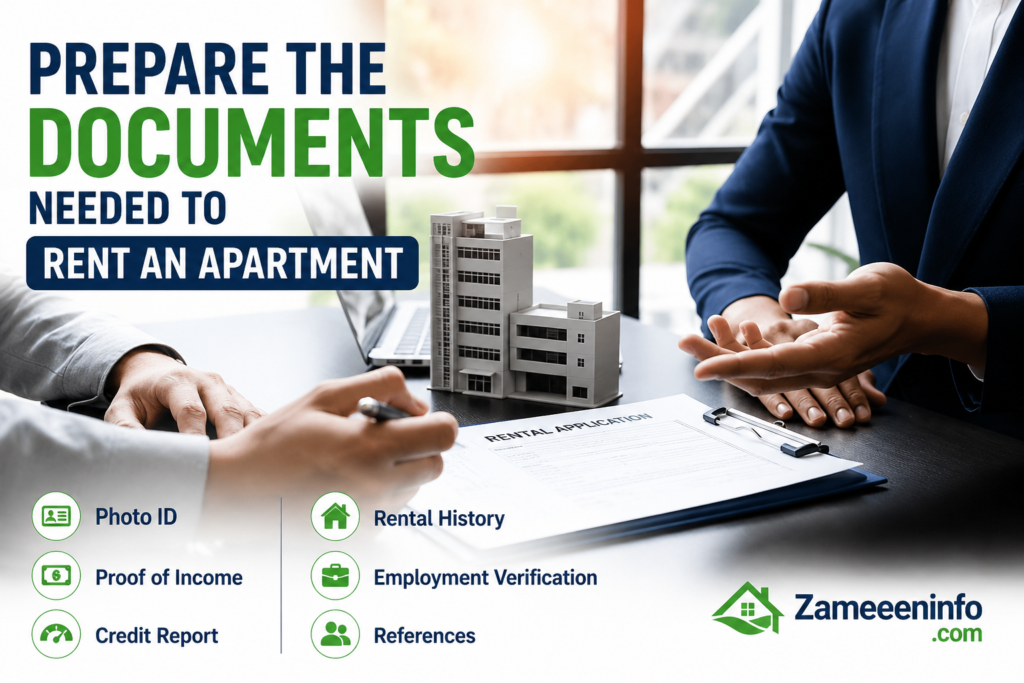
One of the most important apartment rental requirements is documentation. Having everything ready can help you apply faster and improve your chances of approval.
Common documents needed to rent an apartment in the USA include:
- Government-issued photo ID, such as a driver’s license, state ID, or passport
- Social Security number or taxpayer identification information, when required
- Recent pay stubs, usually from the last 2 to 3 months
- Bank statements, especially if you are self-employed
- Employment letter or job offer letter
- W-2, 1099, or tax return, depending on your income type
- Rental history with previous addresses
- Previous landlord contact information
- Personal or professional references
- Vehicle information, if parking is needed
- Pet information, if you have a pet
- Co-signer or guarantor details, if required
If you are a first-time renter and do not have a rental history, use employer references, professor references, bank statements, savings proof, or a co-signer to strengthen your application.
5. Tour the Apartment Before Applying
Never rely only on photos. Before applying or paying a deposit, tour the apartment in person if possible. If you are moving from another state, request a live video tour and confirm the landlord’s identity.
During the tour, check the condition of the apartment carefully. Test faucets, water pressure, lights, outlets, appliances, heating, air conditioning, windows, locks, smoke detectors, and cell phone signal. Look for signs of pests, mold, leaks, broken tiles, damaged flooring, or bad odors.
Ask important questions during the tour:
- What utilities are included in rent?
- How much is the security deposit?
- Is renters’ insurance required?
- What is the lease length?
- Are pets allowed?
- Is parking included?
- How are maintenance requests handled?
- Are there move-in fees or elevator reservation fees?
- What is the policy for guests, subletting, and early lease termination?
- How much notice is required before moving out?
Taking photos and notes during each tour will help you compare apartments later.
6. Submit the Apartment Application
After you find an apartment that fits your budget and needs, the next step is the apartment application process. Most landlords or property managers ask you to complete an application online or in person.
A typical apartment application asks for your full legal name, contact details, date of birth, income, employer information, rental history, references, and permission to run a credit and background check. You may also need to pay an application fee. In many places, application fees are non-refundable, so do not apply blindly to too many apartments.
Before submitting, check every detail. A small mistake in your phone number, employer information, or income proof can delay your approval. If the rental market is competitive, speed matters. A complete application with all documents attached can give you an advantage over other applicants.
7. Understand Credit Checks, Background Checks, and Approval
Many renters ask, “How do I get approved for an apartment?” Approval usually depends on income, credit history, rental history, background screening, and landlord references.
A strong application usually shows:
- Stable income
- Good credit history
- No recent eviction record
- Positive rental references
- Complete documents
- Ability to pay deposit and first month’s rent
- Honest communication
If your credit score is low, you can still rent an apartment, but you may need extra support. You can offer a co-signer, show a larger savings balance, provide employer letters, explain unusual credit issues, or look for private landlords who may be more flexible than large apartment companies.
Do not submit fake pay stubs or false documents. Many landlords verify income and employment. False information can cause denial and may create legal problems.
8. Review the Lease Agreement Carefully
Once approved, the landlord will send a lease agreement. This is the legal contract between you and the landlord. Read it carefully before signing. Do not rush this step, even if you are excited about the apartment.
Important lease terms to review include:
- Monthly rent amount
- Rent due date
- Late fees and grace period
- Lease start and end date
- Security deposit amount
- Refund policy for the deposit
- Utilities included and excluded
- Pet rules and pet fees
- Parking rules
- Maintenance responsibilities
- Guest policy
- Subletting policy
- Early termination fee
- Renewal terms
- Notice period before moving out
If anything is unclear, ask for an explanation in writing. Verbal promises are harder to prove later. For example, if the landlord says parking is included or a broken appliance will be fixed before move-in, ask them to add it to the lease or confirm it by email.
9. Pay the Security Deposit and Move-In Costs
After signing the lease, you will usually pay your security deposit, first month’s rent, and sometimes other move-in costs. Some apartments may also require last month’s rent, pet deposit, parking fee, amenity fee, admin fee, or move-in fee.
Always pay through a secure and traceable method. Avoid cash, wire transfers, cryptocurrency, or gift cards. Keep receipts for every payment. Before paying, confirm that the lease is signed by both parties and that the payment instructions are official.
Security deposit laws vary by state and city. Some places limit how much a landlord can charge, while others have different rules about when the deposit must be returned after you move out. Because rental laws are local, always check the rules in your city or state.
10. Get Renter’s Insurance

Many beginners ask, “Do I need renters’ insurance?” In many apartments, the landlord may require it. Even when it is not required, renters’ insurance is usually a smart idea.
The landlord’s insurance typically protects the building, not your personal belongings. Renter’s insurance can help protect your furniture, electronics, clothing, and other personal items if they are damaged or stolen under covered events. Many policies also include liability coverage and additional living expense coverage if your apartment becomes temporarily unlivable because of a covered loss.
Renter’s insurance is usually affordable compared with the cost of replacing everything you own. Before buying a policy, compare coverage limits, deductibles, exclusions, and whether roommates need separate policies.
11. Complete the Move-In Walkthrough
Before moving your furniture in, complete a move-in inspection. Walk through the apartment and document its condition. Take clear photos and videos of walls, floors, appliances, cabinets, windows, bathrooms, and any existing damage.
Write down scratches, stains, cracks, broken blinds, missing screens, appliance issues, or water damage. Send the list to the landlord or property manager by email so there is a written record. This can help protect your security deposit when you move out.
Also set up utilities, internet, mail forwarding, and renters’ insurance before your move-in date. Ask where moving trucks can park and whether you need to reserve an elevator.
12. Beginner Tips for Renting Your First Apartment
If this is your first time renting an apartment, do not choose only based on photos or luxury amenities. Choose the apartment that fits your real budget, daily routine, and long-term comfort.
Here are practical tips:
- Keep rent affordable, not just barely possible
- Apply only after verifying the listing
- Read every lease clause before signing
- Keep digital copies of all documents
- Pay rent on time every month
- Report maintenance issues in writing
- Respect noise, parking, pet, and guest rules
- Build a positive rental history for future apartments
Your first apartment does not have to be perfect. It should be safe, affordable, legally rented, and suitable for your lifestyle.
13. Best Cities to Rent an Apartment in the USA
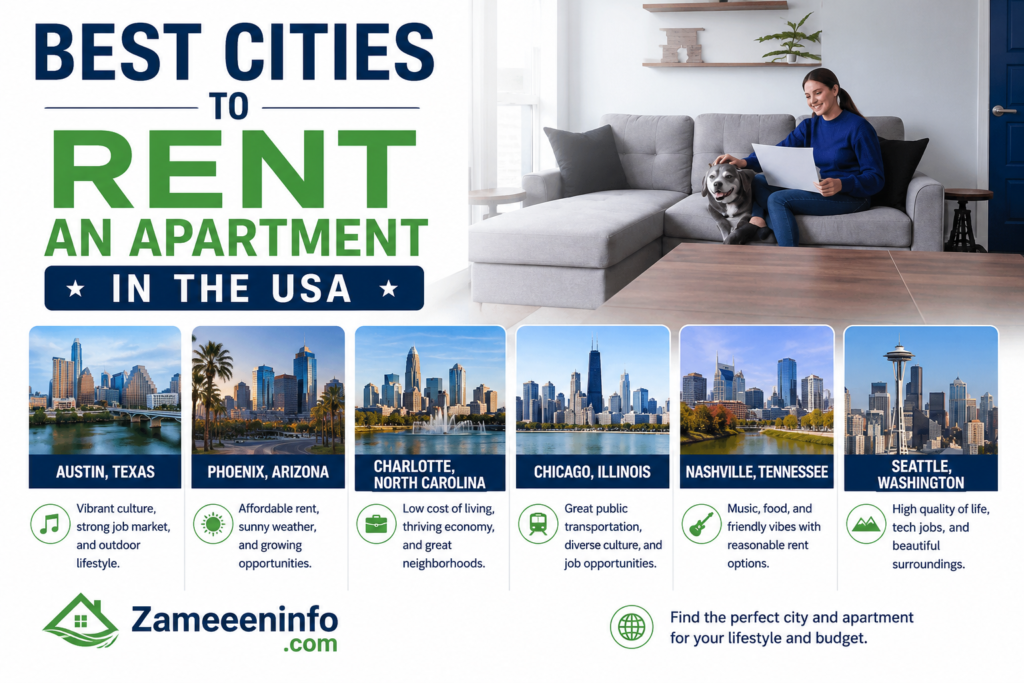
When renting an apartment in the USA, choosing the right city can make a big difference in your monthly budget. Some cities have high job opportunities but expensive rent, while others offer lower apartment costs, larger living spaces, and better value for first-time renters.
The best city to rent an apartment is not always the cheapest city. A smart renter should compare rent, income opportunities, commute time, safety, public transportation, utilities, job market, and lifestyle. For example, a $1,000 apartment may be a good deal in one city, but if the area has limited jobs or long commute costs, it may not be the best choice.
Below are some of the best U.S. cities for renters who want more affordable apartment rent compared with expensive markets like New York City, Los Angeles, San Francisco, Boston, Miami, and Washington, D.C.
| City | Best For | Average Apartment Rent | Why Renters Like It |
|---|---|---|---|
| Wichita, Kansas | Budget renters | Around $950/month | One of the most affordable larger U.S. cities for apartments, with low rent and good space for the price. |
| Tulsa, Oklahoma | First-time renters | Around $1,020/month | Affordable apartments, growing job opportunities, and a lower cost of living than many coastal cities. |
| Oklahoma City, Oklahoma | Families and beginners | Around $1,050/month | Good option for renters who want affordable one-bedroom and two-bedroom apartments. |
| Memphis, Tennessee | Low-cost city living | Around $1,140/month | Lower rent than many large cities, with many apartments suitable for renters on a moderate income. |
| San Antonio, Texas | Affordable Texas living | Around $1,270/month | Cheaper than Austin and many other major Texas rental markets, with a strong city lifestyle. |
| Indianapolis, Indiana | Midwest renters | Around $1,270/month | Balanced rent, job access, and apartment availability for young professionals and families. |
| Louisville, Kentucky | Value and lifestyle | Around $1,300/month | Reasonable apartment rent with a comfortable city lifestyle and good neighborhood variety. |
| Houston, Texas | Big-city affordability | Around $1,350/month | A major U.S. city where renters can often find better value than in New York, Los Angeles, or San Francisco. |
| Detroit, Michigan | Urban renters | Around $1,330/month | More affordable than many major metro areas, though rent and neighborhood quality vary widely. |
| Dallas, Texas | Jobs and city access | Around $1,590/month | More expensive than Houston or San Antonio, but popular for jobs, business, and apartment choice. |
| Cleveland, Ohio | Midwest affordability | Around $1,560/month | Can be a practical choice for renters who want city access with lower rent than many coastal markets. |
Cheapest Cities for First-Time Apartment Renters
If your main goal is low rent, cities like Wichita, Tulsa, Oklahoma City, and Memphis are strong options to consider. These cities usually offer more apartment space for the money compared with high-cost coastal cities.
For a first-time renter, these markets may make approval easier because the required income is often lower. For example, if a landlord requires income equal to three times the rent, a $950 apartment may require about $2,850 in gross monthly income. A $2,000 apartment may require about $6,000 in gross monthly income. This is why city selection matters so much when applying for an apartment.
Best Big Cities for More Affordable Rent
If you want a larger city but still care about affordability, Houston, San Antonio, Indianapolis, and Louisville can be good choices. These cities may offer better rent value than places like New York City, Boston, Seattle, San Diego, or San Francisco.
Houston is often attractive because it is a large employment market with many apartment options. San Antonio can be better for renters who want Texas living at a lower price than Austin. Indianapolis and Louisville are popular for renters who prefer Midwest/South affordability with access to jobs, hospitals, universities, and family-friendly neighborhoods.
Expensive U.S. Cities Where Renters Need a Higher Budget
Some U.S. cities are much harder for beginners because rent is significantly higher. New York City, San Francisco, Boston, Los Angeles, San Diego, Miami, Seattle, and Washington, D.C. often require higher income, better credit, and more savings for move-in costs.
In these cities, renters may need to consider roommates, smaller apartments, outer neighborhoods, longer commute options, rent-stabilized units, or nearby suburbs. For example, instead of renting in Manhattan, some renters compare Brooklyn, Queens, Jersey City, or nearby New Jersey areas. Instead of central Los Angeles, some renters compare the San Fernando Valley, Long Beach, or surrounding cities.
How to Choose the Best City for Apartment Rent
Before moving to a city for cheaper rent, compare the full cost of living. A lower-rent city can still become expensive if wages are low, public transportation is limited, or you need a car for daily travel.
Use this checklist before choosing a rental city:
- Compare average studio, one-bedroom, and two-bedroom rents
- Check local job opportunities in your field
- Calculate transportation and parking costs
- Compare utility costs, especially heating and air conditioning
- Research neighborhood safety and commute time
- Check renter reviews for apartment communities
- Compare state and city tenant protections
- Review local application fees and deposit rules
- Visit the neighborhood before signing, if possible
Best City Rent Tip for Beginners
For first-time renters, the best city is usually the one where you can afford rent comfortably, not the one where you can barely qualify. If your rent takes almost all your monthly income, you may struggle with utilities, food, transportation, savings, and emergencies.
A practical strategy is to choose a city and apartment where your rent stays close to 25% to 30% of your gross monthly income. If that is not possible, consider a roommate, a studio apartment, a less expensive neighborhood, or a nearby suburb.
In simple words, the best apartment rent is not only the lowest rent. It is the rent that gives you a safe home, manageable bills, a reasonable commute, and enough money left after paying rent every month.
Final Thoughts
Learning how to rent an apartment in the USA is mostly about preparation. If you know your budget, prepare your documents, understand the application process, check the apartment carefully, review the lease, and avoid scams, you can rent with confidence.
For beginners, the best strategy is simple: do not rush, do not pay before verifying, and do not sign anything you do not understand. A good apartment should fit both your lifestyle and your financial comfort.
FAQs About Renting an Apartment in the USA
How to rent an apartment for beginners?
Beginners should start by setting a rent budget, choosing a location, searching verified listings, preparing documents, touring apartments, applying, passing credit and background screening, signing the lease, paying move-in costs, and completing a move-in inspection.
Can I afford $1000 rent, making $20 an hour?
If you make $20 per hour and work 40 hours per week, your gross monthly income is about $3,467. Using the 30% guideline, $1,000 rent may be affordable before taxes and utilities. However, you should check your take-home pay, debts, transportation, groceries, and emergency savings before signing a lease.
What are the steps to renting an apartment?
The main steps are: calculate your budget, choose a neighborhood, search listings, prepare documents, tour apartments, submit an application, complete screening, review the lease, pay the deposit and first month’s rent, get renters’ insurance, and move in.
How much should I spend on rent?
A common guideline is to spend around 30% of your gross monthly income on rent and utilities. However, the right amount depends on your city, income, debts, savings, transportation costs, and lifestyle.
What documents do I need to apply for an apartment?
You usually need a photo ID, proof of income, pay stubs, bank statements, employment information, rental history, landlord references, personal references, and sometimes a co-signer or guarantor.
Do I need renters’ insurance?
Many landlords require renters’ insurance. Even if it is optional, it can help protect your personal belongings, liability, and temporary living expenses after certain covered losses.
How do I get approved for an apartment?
To improve approval chances, show stable income, good credit, complete documents, positive references, and enough money for move-in costs. If your credit or income is weak, consider a co-signer, roommate, or private landlord.
What credit score is needed to rent an apartment?
There is no single required credit score for every apartment in the USA. Requirements vary by landlord, city, rent price, and property type. Higher credit helps, but income, rental history, references, and co-signers can also matter.
How long does the apartment application process take?
The apartment application process can take a few hours to several business days. It depends on how fast the landlord verifies your income, credit, background check, rental history, and references.